

Solar Battery Buying Guide: Capacity, Voltage, Chemistry, and Inverter Compatibility
Time : Jul 01, 2026 View : 870
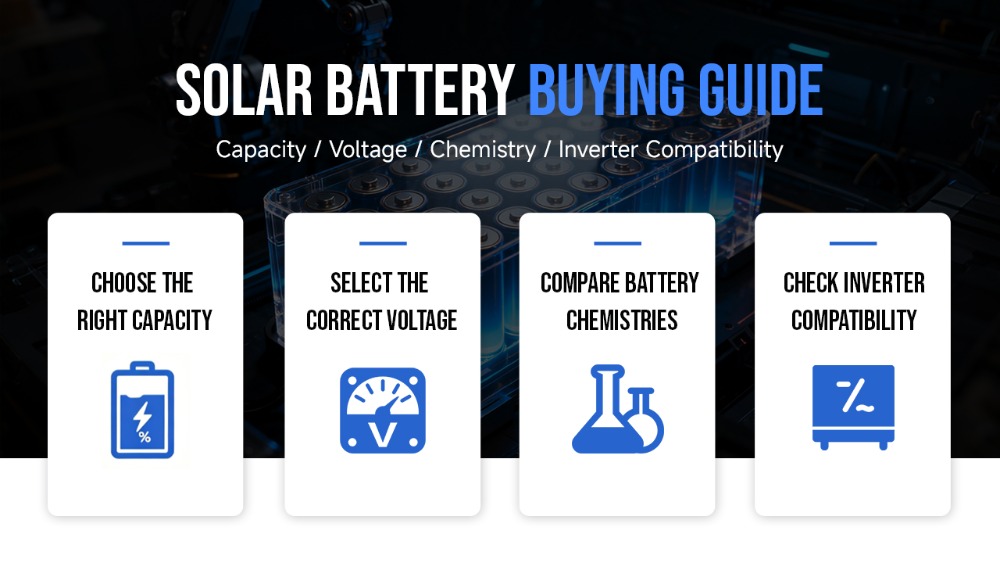
A reliable solar battery storage plan requires four essential checks before price comparison begins. These checks include capacity, voltage, chemistry, and inverter compatibility. If one of these is incorrect, the system may still be installed. However, it might fail to offer the backup time the buyer expected. It might not provide the needed safety margin. It might not achieve the operating stability the buyer expected. This buying guide explains those four points for home battery storage, small commercial solar projects, and off-grid or hybrid systems.
Why Battery Capacity Is Only the Starting Point
Battery capacity tells buyers how much energy can be stored. It does not show the whole performance of the solar battery system.
Capacity Shows Stored Energy
Capacity is generally expressed in kWh. A 5kWh-class battery stores less energy than a 10kWh-class battery. However the better choice depends on the actual load. A small home may only require support for lighting, a router, a refrigerator, and selected outlets during an outage. Therefore it may not need the same capacity. In comparison a house that expects extended backup for air conditioning, pumps, or heavier appliances will likely require more.
Power and Runtime Are Different
Capacity does not show how much power the battery can deliver at one time. That part depends on inverter power, discharge current, BMS limits, and system design. A battery may store enough energy for several hours, but if the inverter output is too low, it cannot support all selected loads together.
Runtime also changes with load size, usable capacity, temperature, discharge depth, and battery age. The better question is not only “how many kWh is enough?” It is “which loads must run, and for how long?”
How to Match Battery Size to Real Use
Solar battery storage should be sized from use behavior, not only from the product list.
Start with Daily and Night Loads
A system used mainly for solar self-consumption should match when the user consumes power. If the home uses much of its electricity during the day, a smaller battery may cover the evening gap. If most demand happens after sunset, capacity should follow the night load.
Define the Backup Target
Backup power should be planned around essential loads first. Refrigerators, routers, lights, security devices, medical equipment, pumps, and selected sockets may be more important than full-building backup.
This approach keeps home battery storage practical and reduces oversizing risk. A buyer can still choose a larger system, but the reason should be clear: longer runtime, more appliances, future expansion, or a weak-grid site.
Why Voltage and Inverter Compatibility Matter
A battery and inverter must work as one system. Matching capacity alone is not enough.
Low-Voltage Batteries Fit Many Home Systems
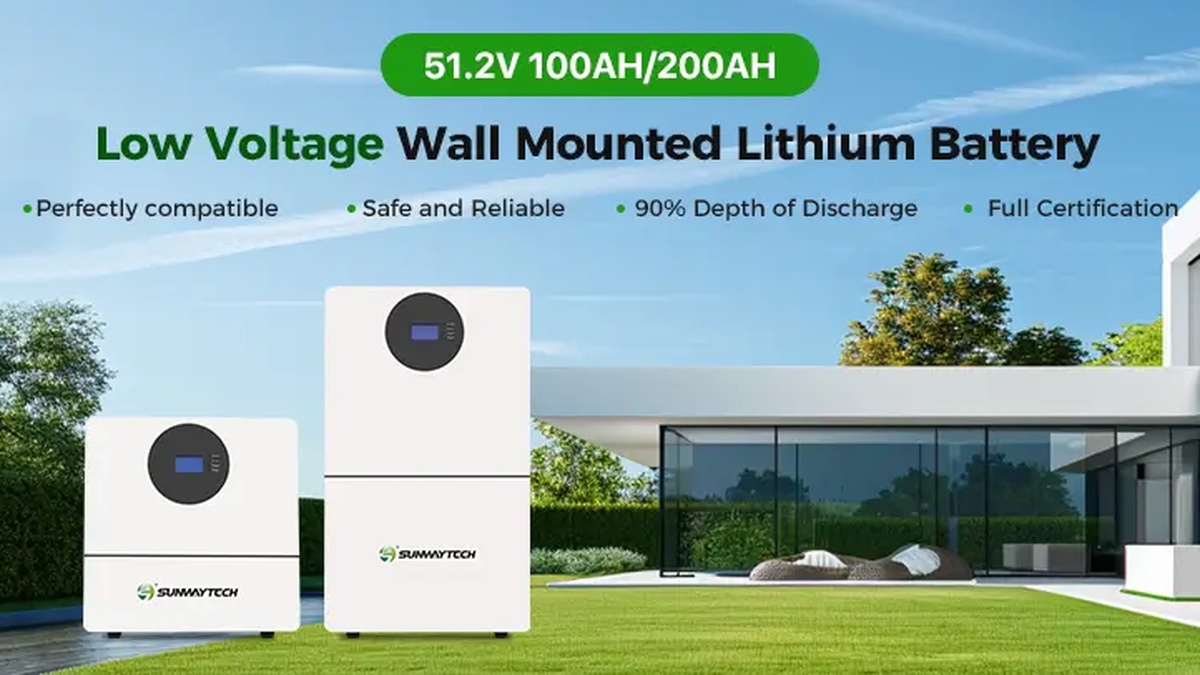
Low-voltage batteries, often around 48V or 51.2V, are common in residential solar and small off-grid systems. They are widely used with hybrid inverters and off-grid inverters. For buyers, the advantage is familiar system design and easier matching with many residential inverter models.
The SUNWAY 5.12kWh / 10.24kWh Wall-Mounted Lithium Battery is a useful reference for this category. It uses a 51.2V platform, LiFePO4 cells, RS485 and CAN communication, and two capacity choices for compact residential or light commercial use. Its wall-mounted casing also helps save floor space.
High-Voltage Batteries Need Correct Matching
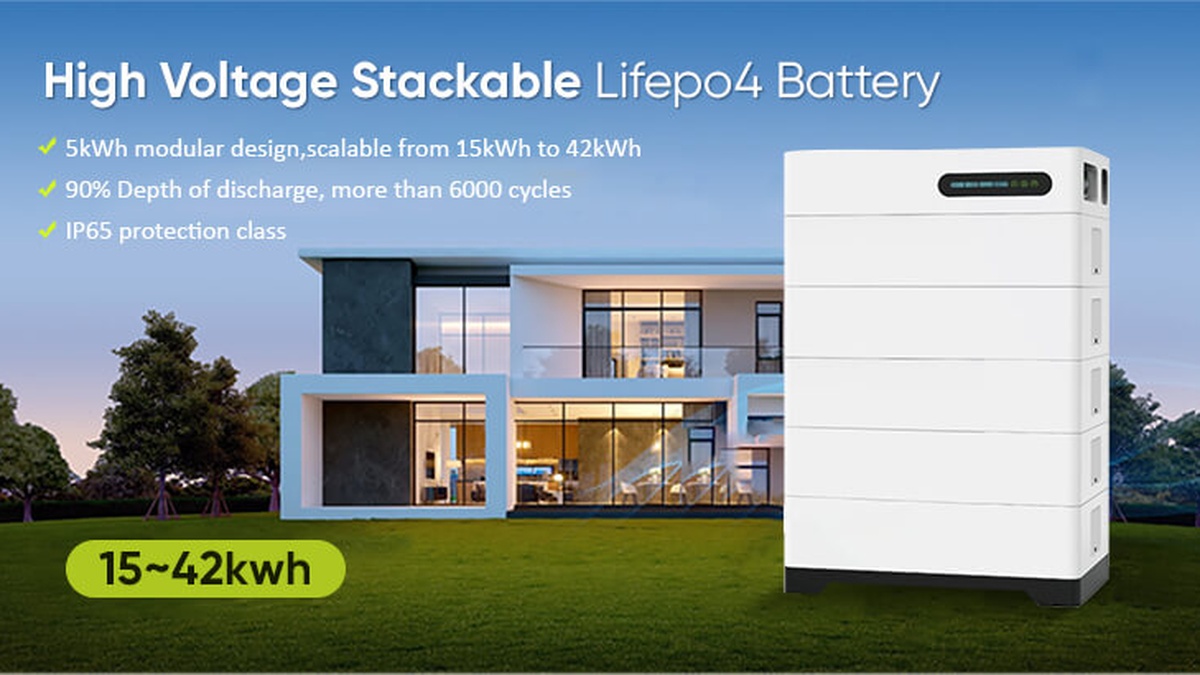
High-voltage batteries are often selected for larger residential systems or light commercial storage projects. These applications often need higher power handling and cleaner expansion. They should not be matched casually with any inverter. The inverter voltage range, inverter model, current limit, battery protocol, and BMS communication must be confirmed first.
The SUNWAY 15-42kWh Stackable High-Voltage ESS fits this type of selection discussion. It starts from a 15kWh base setup. It can scale to a 42kWh battery system with 5kWh modules. It uses LFP cells. It supports CAN communication and RS485 communication. It has an IP65-rated casing for suitable installation conditions.
Communication Is Part of Compatibility
Inverter compatibility is not only a voltage question. The battery and inverter also need to communicate correctly. CAN and RS485 are common interfaces. Through communication, the inverter can read battery status, charge limits, discharge limits, alarms, and state of charge.
If communication is not checked, the system may rely on basic voltage control only. That can affect protection logic and user experience, especially in systems that need automatic backup or solar self-consumption control.
Which Battery Chemistry Works for Solar Storage?
Battery chemistry affects safety, cycle life, weight, maintenance, and usable energy.
LiFePO4 Is Common for Modern Solar Batteries
LiFePO4, also called LFP, sees common use in lithium solar battery products. It handles frequent charging and discharging with ease. People also prefer it for stable operation. It further provides lower maintenance needs than many older battery types.
For solar battery storage, this detail is significant. The battery might cycle each day. A unit that appears cheaper at the beginning may not remain a good economic choice. This occurs if usable capacity is limited, replacement frequency is high, or maintenance demands are substantial.
Lead-acid and gel batteries can still work for budget-sensitive or light-duty uses. Buyers should review several points carefully. These points include weight, discharge depth, maintenance needs, cycle life, and installation space. In daily home energy storage, lithium batteries often prove simpler to manage. They show this benefit when frequent cycling is common, installation must be compact, and system communication is necessary.
Which Battery Form Fits the Project Space?
The physical format affects installation, service, and future expansion.
| Battery Form | Typical Use | Main Buying Question |
| Wall-mounted battery | Homes, garages, utility rooms | Is the wall strong enough, and is the capacity enough for essential loads? |
| Rack-mounted battery | Larger homes, small business sites, equipment rooms | Does the rack allow safe expansion and service access? |
| Stackable high-voltage battery | Larger residential or light commercial systems | Does the inverter match the battery voltage and communication protocol? |
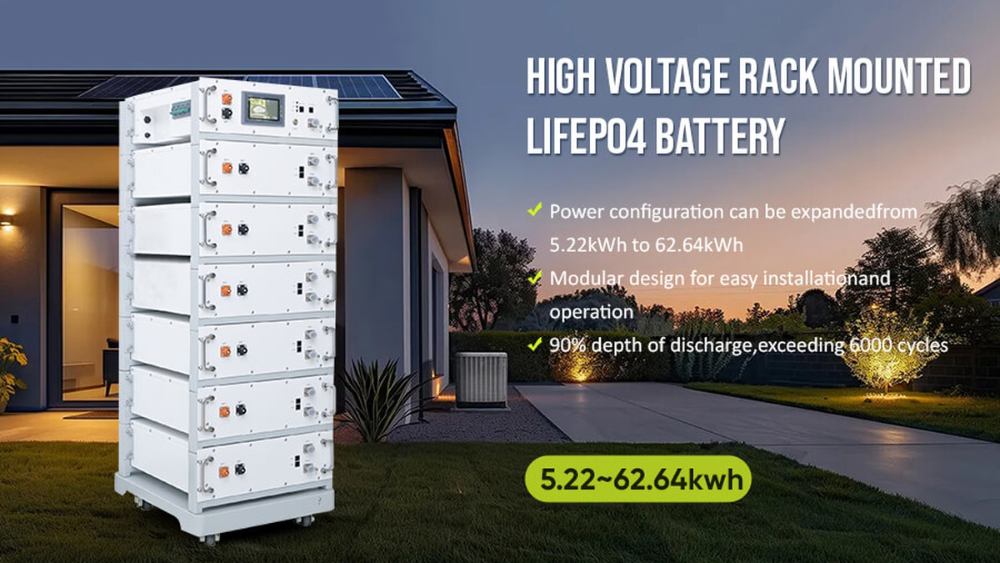
The SUNWAY 5.22-62.64kWh Rack-Mounted Battery is suited to scalable storage layouts. It uses a 51.2V LiFePO4 platform and can expand from 5.22kWh to 62.64kWh by combining modules in a rack. It also includes BMS protection, RS485 and CAN communication, and thermal aerosol fire protection.
What Buyers Should Confirm Before Ordering
Before choosing an energy storage battery, buyers should confirm battery capacity, usable capacity, voltage range, battery chemistry, inverter compatibility, BMS communication, installation space, and expansion plan.
For product category planning, the residential ESS page can help buyers compare different residential storage formats before choosing one battery type. Local certification and installation rules should still be checked before final purchase.
Common Buying Mistakes
The first mistake is choosing by price only. A low initial price may not mean low long-term cost if the battery has limited usable capacity, weak communication, or short cycle life.
The second mistake is choosing too much capacity without enough solar input. If the PV array is small, a large battery may not charge fully in daily use.
The third mistake is assuming any battery works with any inverter. A solar battery system needs voltage, current, and communication matching before it can operate reliably.
Where Sunway Products Fit in Battery Selection
Sunway provides solar panels, solar inverters, energy storage batteries, on-grid systems, off-grid systems, hybrid systems, and solar energy storage solutions. In battery selection, our role is not only to offer a product list. The more useful step is matching battery type with the user’s load, inverter, solar array, installation space, and backup target.
A wall-mounted battery may suit basic home backup. A rack-mounted battery may suit future expansion. A high-voltage stackable system may suit larger homes or light commercial projects that need a higher-capacity solar battery system.
Turn Battery Parameters into a Practical System Choice
Choosing a solar battery becomes easier. This occurs when the load, inverter, PV array, installation site, and backup goal receive joint consideration. Share your daily electricity use with us. Provide the essential load list as well. Include the inverter model, PV capacity, preferred battery voltage, installation space, and expansion plan. We can then assist in assessing whether a wall-mounted battery, rack-mounted battery, or stackable high-voltage energy storage battery is more suitable for your home, apartment, small business, or off-grid project. Send your battery project details for a practical configuration review.
FAQ
Q:What size solar battery do I need for a home?
A:It depends on daily electricity use, essential loads, backup hours, usable capacity, and PV input. A smaller home may only need a 5kWh-class battery for basic backup, while larger homes or longer backup needs may require 10kWh or more.
Q:Is LiFePO4 suitable for solar battery storage?
A:LiFePO4 is widely used in solar battery storage because it supports frequent cycling, stable operation, and lower maintenance than many traditional battery types. The final choice should still match budget, inverter compatibility, installation space, and backup target.
Q:Can any solar battery work with any inverter?
A:No. Buyers should check voltage range, charge and discharge current, BMS communication, CAN or RS485 protocol, and the inverter’s battery compatibility list before ordering.