

How Much Battery Storage Does a DC Fast Charging Station Need?
Time : Nov 02, 2026 View : 254
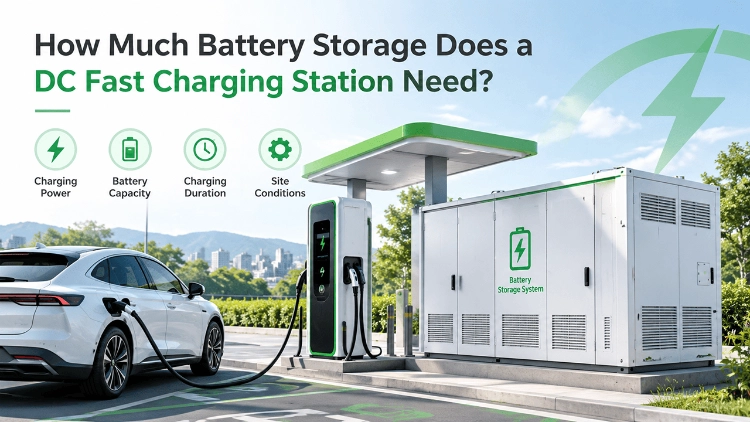
Battery storage for a DC fast charging station should be sized around the demand the site must serve, not by multiplying charging guns by their rated output. The configuration depends on simultaneous vehicle demand, available grid supply, and battery recovery time.
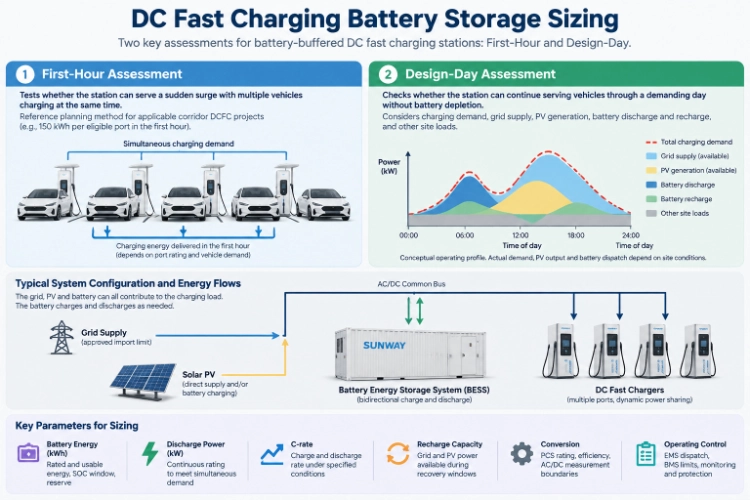
Two checks are useful: the First Hour test examines a sudden surge; the Design Day test checks whether the station can keep serving vehicles through a demanding day. Both must be considered alongside discharge power, usable state of charge (SOC), and recharge capacity.
Buyer checkpoint: A sizing proposal should show the charging profile, available grid input, required battery power, usable energy, and recovery window. A nameplate kWh figure alone cannot confirm whether a system will meet the site’s operating requirements.
Why Is Charger Nameplate Power Not Enough?
A DC fast charger rated at 150 kW does not necessarily draw or deliver 150 kW throughout every session. Vehicle battery size, initial SOC, temperature, and the charging curve affect the power accepted. A vehicle approaching a high SOC may taper its charging rate, while another arriving with a low SOC may initially request much more power.
The number of charging guns is not enough either. Four ports may share a station-level power limit or dynamic power-sharing arrangement. Public sites have irregular arrivals; fleet depots may see several vehicles return within a short window.
Before estimating battery storage for DC fast charging, collect the number of ports, rated output per port, expected sessions, energy per session, arrival times, dwell periods, and simultaneous demand. Add existing site loads, the approved grid-import limit, and an hourly PV forecast if solar is included.
Keep the measurement boundary consistent. Charger DC output, battery-side discharge, and grid-side AC input are different quantities. Conversion losses and auxiliary loads matter when comparing figures from different sides of the system.
What Does the First-Hour Test Tell Buyers?
|
First-hour input |
Illustrative value |
|
Charging ports |
4 |
|
Energy target per port |
150 kWh |
|
Combined first-hour demand |
600 kWh |
|
100 kWh |
|
|
Required battery-path delivered energy |
500 kWh usable |
|
Required average battery contribution over one hour |
500 kW |
This is a planning example, not a universal requirement. The 150 kWh reference is intended for corridor DCFC ports rated at 150 kW or above. Commercial parking, fleet depots, and lower-power sites should use demand profiles suited to their vehicles and service requirements.
The result is usable energy, not nominal capacity. The battery must provide it within the permitted SOC window and after discharge losses and reserve are considered.
How Does the Design Day Test Change the Sizing Decision?
Passing the First Hour test does not prove that a station can operate through a busy day. A battery may support the initial rush, then lose SOC as more vehicles arrive. If grid and PV input cannot replace the energy being used, it may reach its minimum operating limit before the next peak.
The Design Day is the demanding day the station is intended to serve without interruption caused by battery depletion. A project may select a forecast high-demand day, such as a defined percentile of projected traffic, but should state the forecast year and percentile rather than treat them as universal values.
Two conditions matter. Available grid power should cover at least the average charging demand over the Design Day. The battery must also have enough usable energy to support periods when demand rises above available grid power, with realistic opportunities to recharge between peaks.
This test exposes a daily energy imbalance. If vehicle demand exceeds the energy the grid and PV can supply, a larger battery cannot solve the shortfall indefinitely. The project may need a higher grid connection, more PV generation, a longer charging window, lower throughput assumptions, or a revised operating plan.
How Should Buyers Check Battery Energy and Discharge Power?
Battery capacity and discharge power solve different problems. Capacity, measured in kWh, indicates how much energy can be stored. Discharge power, measured in kW, determines how quickly it can be delivered. A system may have enough kWh but insufficient instantaneous power for several chargers.
For an individual event, a first estimate is:
Required delivered energy (kWh) = battery output power (kW) × duration (hours).
For example, a 100 kW battery contribution sustained for 45 minutes requires 75 kWh delivered at the defined output boundary. This is not nominal battery capacity. The estimate must be adjusted for the permitted SOC window, discharge efficiency, reserve, and capacity expected at the design-life point.
Can the Battery Recharge Before the Next Charging Peak?
A station may pass the First Hour test and still be unsuitable if the battery cannot recover before another group of vehicles arrives. The recharge window depends on grid headroom, PV production, other site loads, and the battery’s permitted charge rate.
Compare the energy discharged during a busy period with the power available afterward. A battery that supplies 150 kWh during one peak will not necessarily regain it in the next hour. The grid may still serve active chargers, while the EMS must preserve an SOC reserve.
The Design Day model should track SOC across the schedule: when charging begins, how much power can be allocated to the battery, whether PV contributes, and whether the battery is ready for the next peak. Repeated SOC decline may call for a longer recovery window, different grid allocation, additional PV, fewer simultaneous sessions, or more storage.
What Should Buyers Ask BESS Suppliers to Provide?
When comparing BESS suppliers, ask for evidence that the configuration meets both power and energy requirements. A qualified battery energy storage system supplier should explain the assumptions behind its proposal, not just list battery capacity and charger power.
|
Procurement item |
What the buyer should confirm |
|
Charger configuration |
Ports, rated output, station limit, power sharing |
|
Site supply |
Approved grid-import limit and existing loads |
|
Battery energy |
Rated kWh, usable kWh, SOC window, reserve |
|
Battery power |
Continuous discharge rating and C-rate |
|
Conversion |
PCS rating and AC/DC measurement boundaries |
|
Operating controls |
EMS dispatch, BMS limits, monitoring |
|
Integration |
Communication interfaces and charger compatibility |
|
Project delivery |
Supply scope, drawings, commissioning, service |
Ask for a First Hour calculation, a Design Day SOC profile, and the assumed grid and PV contribution. The proposal should identify minimum SOC, recovery time, and operating conditions that trigger charger power limits. For planned expansion, include additional ports and expected utilization; a first-phase configuration may not support a larger station later.
Which SUNWAY Integrated Configuration Should Be Reviewed?
For a wider view of the company’s solar and storage portfolio, visit Sunway.
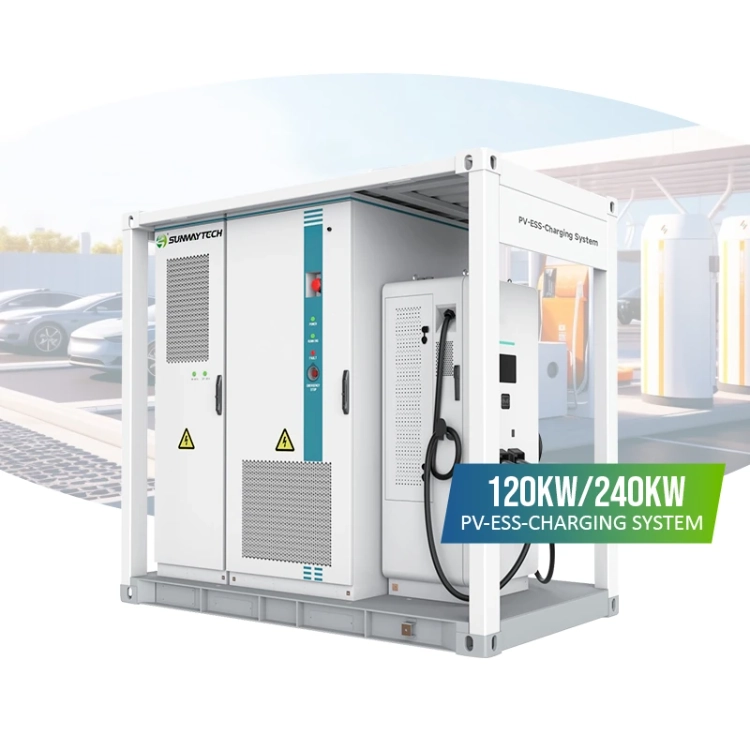
The SUNWAY Integrated PV-ESS-Echarging System combines LFP battery storage, DC fast charging, direct DC PV input, and energy management in two configurations. The SW120kW241kWh-PSC provides 241.15 kWh of rated battery energy, 120 kW of rated DC charging power, and two charging guns. The SW240kW482kWh-PSC provides 482.3 kWh, 240 kW, and four guns.
Both specify a 0.5C battery charge/discharge rate and intelligent liquid cooling. The product information lists DC-coupled PV input ranges of 60–240 kW and 60–480 kW respectively, plus OCPP 1.6 and Modbus communication. These are equipment specifications, not a guarantee of site throughput or Design Day performance.
Buyers should compare the ratings with their grid limit, charging profile, required battery contribution, and recharge window. Gun count alone is not enough to select a model. Explore the PV ESS Charging System range for the broader integrated product category.
To assess a project, request a configuration review from Sunway with the charger schedule, grid capacity, site load, and PV forecast.
Conclusion
The right battery storage capacity depends on First Hour demand, Design Day energy balance, discharge power, and recovery between peaks. A sound proposal should show usable kWh, continuous kW, C-rate, SOC limits, conversion assumptions, and recovery time so buyers can compare suppliers against a defined operating requirement.
For a related discussion of grid headroom and battery-buffering limits, read Can Battery Storage Reduce EV Charging Grid Upgrade Costs?.
FAQs
Q1: How much battery storage does a four-port DC fast charging station need?
A: There is no universal capacity. Under the First Hour reference for corridor DCFC, four eligible ports would need to deliver 600 kWh in the first hour. If the grid supplies 100 kWh, the battery contribution is at least 500 kWh of usable energy. Design Day and recharge requirements must also be checked.
Q2: Is battery capacity more important than discharge power for EV charging?
A: Both matter. Capacity determines how much energy is available over time; discharge power determines whether the system can support simultaneous charging demand. The PCS and battery limits must satisfy both.
Q3: Can solar PV reduce the battery capacity required at a DC fast charging site?
A: PV can reduce energy drawn from the battery or grid when generation coincides with charging demand. Its contribution depends on hourly output, weather, season, and charging schedule. Annual PV generation alone cannot determine battery size.