

Does Battery Cycle Life Predict How Long an ESS Will Last?
Time : Nov 09, 2026 View : 192
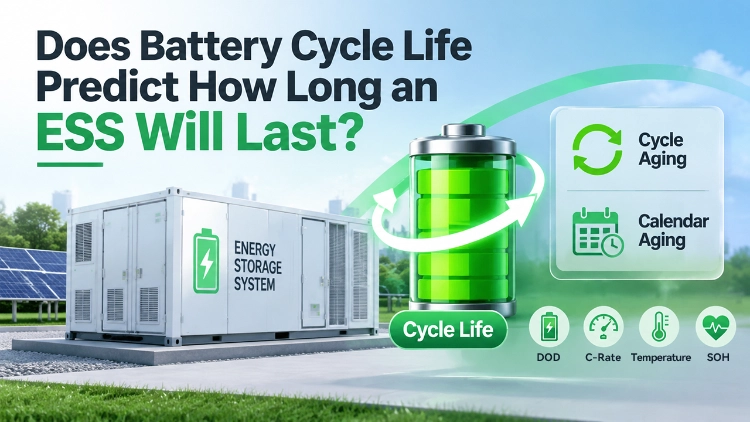
A battery advertised with 6,000 cycles may look suitable for a storage project expected to operate for 15 years. Yet dividing that cycle count by 365 cannot establish its service life. The stated cycles were measured under particular test conditions, while a working battery ages through both repeated use and time spent at rest.
For commercial and industrial ESS buyers, the relevant question is whether the supplier’s lifetime evidence matches the planned duty cycle. Daily charge and discharge, long standby periods, operating temperature and the system’s state-of-charge (SOC) controls all influence the result.
Buyer checkpoint: Request the cycle-life test conditions, end-of-life capacity criterion, expected operating profile and warranty terms together. A cycle count without those details is not a reliable basis for replacement planning.
Why Can’t a Cycle Count Tell You the Service Life?
Battery cycle life usually describes how many defined charge-discharge cycles a cell or battery can complete before reaching a specified performance threshold. That threshold may be expressed as retained capacity. The number is meaningful only alongside the test’s depth of discharge (DoD), temperature, charging rate and discharge rate.
A stated 6,000 cycles is not a promise of 6,000 calendar days. A facility may cycle twice on some days and remain idle on others. Partial cycling also complicates comparison with real operating patterns.
Service life concerns how long the installed ESS meets usable-energy, power and safety requirements. An aged battery might still work but no longer support a required peak-shaving period. Replacement depends on the application, not simply a cycle counter.
How Are Cycle Aging and Calendar Aging Different?
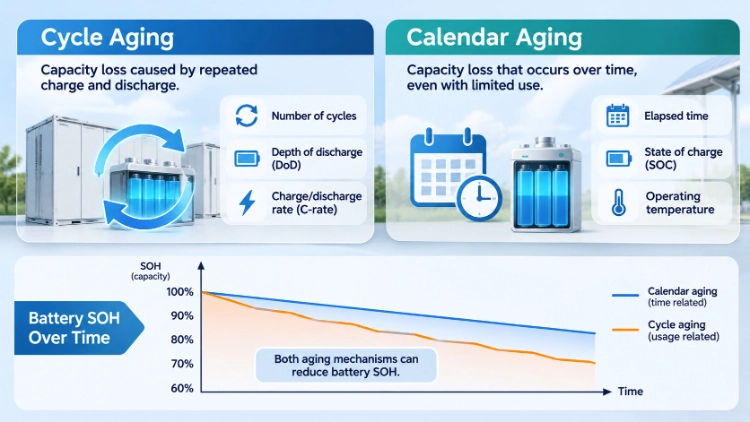
Cycle aging develops as a battery charges and discharges. Electrochemical and mechanical changes can reduce accessible capacity and raise resistance. Its rate depends on the number and nature of cycles, rather than just whether the battery was used on a particular day.
Battery calendar life reflects aging with elapsed time, including while resting. Temperature and SOC influence that aging. A standby system may complete few cycles but still lose capacity; a daily-cycling system experiences both mechanisms.
|
Aging mechanism |
Main exposure |
What a buyer should check |
|
Cycle aging |
Repeated charge-discharge operation |
Cycles, DoD, C-rate and test endpoint |
|
Calendar aging |
Time at specified SOC and temperature |
Years, storage conditions and capacity trend |
The mechanisms can interact and should not be treated as two fixed percentages. The National Renewable Energy Laboratory’s PySAM Battery model exposes separate inputs for cycle-life degradation and calendar degradation, illustrating why both should be considered in a battery lifetime assessment.
How Do DoD, C-Rate and Temperature Affect Battery Aging?
A deeper discharge uses a larger portion of available battery energy per event. A wider DoD window may be useful for the project, but cycle-life data obtained at one DoD should not be transferred unchanged to another. When comparing two quotations, establish whether their cycle claims were tested over equivalent discharge windows.
C-rate describes current relative to rated ampere-hour capacity; system power also depends on voltage. High-current operation can increase heat and, under some conditions, deterioration. Permitted rates may vary with temperature and SOC.
Temperature affects both types of aging. Thermal controls help manage conditions, but liquid cooling does not establish a cycle-life figure. Buyers should request ambient limits, temperature controls and power-derating conditions.
How Does BMS Protection Help Manage Battery Aging?
A battery management system (BMS) monitors voltage, current, temperature and estimated SOC. Protection logic can restrict charging or discharging outside defined limits, while balancing helps manage cell differences. These functions do not stop normal aging.
For a supplier comparison, ask how overcharge, overdischarge, overcurrent and temperature protections operate, and what data the monitoring system records. The practical issue is whether protection thresholds and the energy management system (EMS) strategy are compatible with the lifetime assumptions in the proposal.
What Does State of Health Tell You About Remaining Capacity?
Battery state of health (SOH) describes condition relative to a reference, often capacity or resistance. A battery at 100% SOC may still hold less energy than when new. SOC describes charge level; SOH describes condition.
Consider a purely illustrative battery initially measured at 100 kWh under a specified test procedure. If it later delivers 80 kWh under comparable conditions, its capacity-based SOH would be approximately 80%. That does not mean every ESS must be replaced at 80%. The acceptable endpoint depends on the supplier’s definition and the project’s required energy and power.
An ESS may remain usable below the original capacity if its duty is light. Another project may need more reserve and reach its practical replacement point earlier. SOH estimates can also vary with measurement conditions and the estimation method, so request how the value is determined and verified.
Why Do Daily-Cycling and Standby Systems Age Differently?
A commercial battery used for daily solar shifting regularly moves energy between charging and discharging. Its lifetime study should reflect the expected number of operating events, DoD distribution, power levels and exposure to high or low SOC.
A battery maintained mostly for emergency backup may complete far fewer cycles. Nevertheless, calendar aging continues while it waits, especially if the storage temperature and SOC policy differ from the conditions assumed by the supplier. Occasional maintenance tests, outages and recovery charging should also be accounted for.
Equivalent full cycles (EFC) provide one way to describe irregular cycling. For example, 50 kWh of discharge throughput from a battery with a 100 kWh nominal reference is approximately 0.5 EFC on that energy basis. EFC helps normalize throughput; it does not make every partial cycle as damaging as every other one. Cycle depth, temperature and charge rate still matter.
How Should Buyers Read a Battery Cycle-Life Datasheet?
Start with the performance endpoint. A statement such as “6,000 cycles” is incomplete without knowing what capacity remains at the end of the test. A result reported at 80% retained capacity cannot be compared directly with one using a different endpoint.
Next, check the operating conditions: DoD, charging and discharging current, test temperature, resting periods and any special test procedure. Confirm whether the evidence is for an individual cell, a module or an assembled battery system. Cell results may not incorporate cabinet thermal management, auxiliary equipment or the actual dispatch schedule.
For long-term project evaluation, ask for the capacity-retention curve or test report rather than only a single end-point figure. The curve may help the engineer compare expected degradation with the minimum usable energy required as the installation ages. Model projections should be identified as projections, not presented as field-verified results.
Finally, distinguish battery-life evidence from an ESS warranty. A warranty may specify years, throughput, operating limits, exclusions and remedies. Neither a test cycle count nor a warranty term alone guarantees continuous operation for the same number of years.
What Should Buyers Verify with BESS Suppliers?
Battery energy storage system suppliers should be able to link lifetime claims to a proposed operating profile. A buyer comparing two C&I quotations can request the same supporting information from each supplier.
|
Procurement document |
Question to resolve |
|
Lifetime test report |
What DoD, C-rate, temperature and endpoint were used? |
|
SOH definition |
How is capacity retention measured or estimated? |
|
Operating envelope |
What SOC, current and temperature limits apply? |
|
BMS protection description |
What triggers restrictions, shutdowns or alarms? |
|
Warranty terms |
Which years, throughput limits and exclusions apply? |
|
Project duty-cycle study |
What energy and power remain at the design-life point? |
The most useful response is not necessarily the supplier with the highest advertised cycle count. It is the one that can show how its assumptions relate to daily throughput, reserve requirements, climate and future operating changes. For custom projects, the buyer should also confirm who is responsible for monitoring, service, spare parts and performance investigations.
How Should SUNWAY ESS Be Assessed for Long-Term Use?

Sunway offers energy storage equipment for different application scales. The C&I ESS product range includes integrated cabinets for commercial and industrial use, where operating schedules and control settings influence the expected lifetime duty.
Those features are relevant to operating control, but the published product information does not establish a verified system-level cycle-life claim for this model. Buyers should therefore request the applicable lifetime test documents and warranty conditions rather than infer a lifespan from battery chemistry, cooling or cabinet ratings alone.
Conclusion
Battery cycle life cannot independently predict how many years an ESS will remain suitable for a project. Cycle aging, calendar aging, SOH limits and the actual operating profile all contribute to the answer. Buyers should compare test endpoints and operating conditions before treating supplier cycle counts as equivalent.
For a project-specific review, Request an ESS lifetime and duty-cycle review, including the SOC window, site temperature and required usable energy at the end of the planned service period.
For the related distinction between permitted discharge windows and usable energy, see the guide to SOC and depth of discharge.
FAQs
Q1: Does a 6,000-cycle battery necessarily last 16 years?
No. Dividing 6,000 cycles by 365 assumes one identical cycle every day and ignores calendar aging, temperature, DoD, C-rate and the capacity threshold used in testing. The actual service life needs a project-specific assessment.
Q2: How long do solar batteries last when rarely cycled?
There is no universal number of years. Calendar aging continues even with limited cycling; SOC and temperature during storage matter. Remaining battery capability must be checked against application requirements.
Q3: Is battery warranty life the same as expected service life?
No. A warranty is a contractual commitment subject to stated terms and conditions. Expected service life is an engineering projection based on the duty cycle, environment, degradation assumptions and required end-of-life performance.