

High-Voltage vs Low-Voltage Batteries for Solar Storage
Time : Sep 14, 2026 View : 299
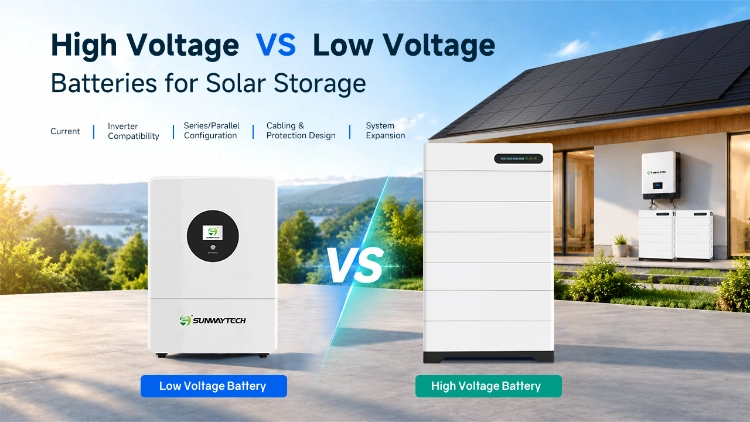
Battery voltage is only useful when it is viewed as part of the whole storage system. A 48 V battery and a 300 V battery may store a similar amount of energy, yet they place very different electrical demands on the inverter and DC side. Current levels, cable requirements, protection devices, module connections, and expansion options can all change with the chosen voltage architecture. For solar battery storage, those practical differences are usually more important than the label itself.
High-voltage and low-voltage are also not fixed categories across every solar storage product. One manufacturer may use a different operating range from another, and inverter designs vary in the same way. In practice, the battery voltage has to fit the inverter’s operating window and the power the system is expected to deliver. Installation conditions and future capacity plans then help determine whether a lower- or higher-voltage architecture makes more sense.
What Actually Makes a Solar Battery High or Low Voltage?
A low-voltage battery system generally operates with a lower DC battery bus and often expands capacity by adding compatible battery units in parallel. A high-voltage battery system builds a higher DC bus, commonly by connecting compatible battery modules in series under a coordinated BMS.
The labels are useful when comparing storage products, but they do not define one fixed voltage boundary for every system. What matters in practice is the battery’s real operating range and whether that range fits the inverter. Insulation, protection, and local electrical requirements also need to be checked against the actual system voltage rather than the marketing category.
Sunway uses both architectures in its residential storage portfolio. Some systems combine wall-mounted low-voltage batteries with compatible hybrid inverters. Other configurations use stackable high-voltage modules with inverter platforms designed for a higher battery-side voltage. The two approaches serve different system designs rather than representing a simple basic-versus-premium choice.
How Does Battery Voltage Affect Current?
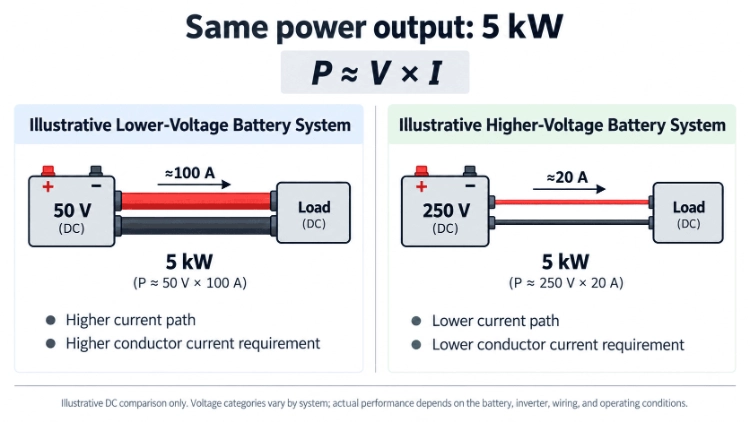
The link between voltage and current becomes clearer when power is held constant. For a simplified DC calculation, the relationship can be written as:
P ≈ V × I
Take a 5 kW load as a simple example. At a theoretical 50 V DC bus, supplying that power would require about 100 A. Raise the bus voltage to 250 V and the current falls to about 20 A. Real battery systems will not match these ideal numbers exactly because voltage changes during operation and the inverter, wiring, and battery all introduce limits and losses.
Lower Current Can Change the DC-Side Design
When the same power is transferred at a higher voltage, less current has to pass through the DC circuit. That can ease the current load on cables, busbars, connectors, and switching devices. It can also reduce resistive loss in parts of the circuit, although the actual improvement depends on conductor size, length, resistance, and operating current.
That advantage should not be confused with total system efficiency. A high-voltage battery still works through an inverter and other electrical components, each with its own losses. Battery resistance, cable length, conversion stages, temperature, and operating point all influence the final result. A higher battery voltage can help in one part of the design without automatically making the whole system more efficient.
Higher Current Is Not Automatically a Design Problem
A low-voltage system is not inherently inefficient or poorly suited to useful power levels. If the inverter and battery are designed for the required current, the architecture can work well within its intended range. As power rises, however, the DC side may need heavier conductors, higher-current connectors, or additional parallel battery paths. Those practical requirements are part of the system design.
Battery voltage therefore makes more sense when it is considered together with the required system power and current, rather than assessed as a specification on its own.
How Are High- and Low-Voltage Battery Systems Built Differently?
One of the main differences appears in the way battery modules are connected and managed.
Series Connections Build Voltage
When identical battery modules are connected in series, their voltages add while the ampere-hour capacity of the string remains the same. A high-voltage stack may therefore use several modules in series to reach the inverter’s required battery operating range.
The BMS must supervise the complete stack. Module count, voltage limits, firmware, communication, and balancing strategy need to remain compatible across the system.
Parallel Connections Build Capacity at the Same Voltage
When compatible battery units are connected in parallel, system voltage stays approximately the same while available ampere-hour capacity increases. This architecture is common in many low-voltage storage systems.
Parallel expansion also has limits. Current sharing, cable symmetry, protection, master/slave communication, and the maximum number of approved battery units must all be considered. Batteries should never be added in arbitrary combinations simply because their nominal voltage appears similar.
Why Does Battery Inverter Compatibility Matter?
Battery inverter compatibility is more than matching one voltage number. The battery and inverter need to operate across compatible electrical and communication limits.
Before combining a battery and inverter, check:
- battery operating voltage range
- inverter battery-input voltage range
- maximum charge and discharge current
- battery and inverter power limits
- BMS communication protocol
- CAN or RS485 support where required
- permitted module or string quantity
- firmware and approved compatibility requirements
- backup operating mode, if backup is part of the project
Sunway’s high-voltage three-phase inverter platform illustrates why the inverter operating-voltage range must match the selected battery stack. Its SW3-30KHP3EU2 platform operates across a 150–800 V range. Low-voltage inverter platforms likewise have their own charge and discharge current limits, which should be checked as part of the complete system design.
A matching voltage range is necessary, but it is not enough. If BMS communication is unsupported, the permitted battery configuration is exceeded, or current limits do not align, the system may not charge, discharge, or protect the battery as intended.
Does Higher Battery Voltage Always Mean Better Efficiency?
No. Higher battery voltage can reduce current for the same power, and that may reduce resistive losses in parts of the DC path. But system efficiency is the result of the complete electrical architecture.
A high-voltage system may still lose energy through the battery, inverter, switching devices, wiring, standby loads, and thermal management. A well-designed low-voltage system can also operate efficiently within its intended power range.
The better comparison is therefore project-specific. Review the expected power level, cable distance, inverter performance, operating voltage, charging profile, and installation constraints. Do not use the voltage label as a substitute for system efficiency data.
How Do Voltage Levels Affect Expansion, Wiring, and Installation?
Voltage architecture influences how a system grows and what the installer needs to manage.
Expansion Must Follow the Original Architecture
A stackable high-voltage battery often expands by adding compatible modules to a series-managed stack. A low-voltage battery bank may expand through approved parallel units. Both approaches can be modular, but neither is unlimited.
Future expansion should be considered before the first installation. Check maximum module count, BMS capacity, inverter voltage window, maximum current, floor space, communication addresses, cable routing, and protection equipment.
Voltage and Current Create Different Installation Priorities
A higher DC voltage places more attention on insulation, isolation, switching, electrical clearances, and safe service procedures. Installation work also needs to follow the requirements that apply to the actual system voltage.
With a lower-voltage system, voltage stress is lower, but current can become substantial as power increases. Cable size, terminal resistance, overcurrent protection, and connection quality then become especially important.
Safety cannot be reduced to “high voltage versus low voltage.” It depends on the complete battery system, enclosure, BMS, protection design, installation quality, and applicable electrical requirements.
Which Battery Voltage Architecture Fits Different Solar Storage Projects?
There is no universal dividing line where one architecture becomes the correct answer.
Low-voltage storage may be practical when the project uses a compatible low-voltage inverter, required power is moderate, parallel battery expansion fits the design, and the installation favors a lower-voltage battery bus. Sunway’s residential ESS range includes both low-voltage and high-voltage configurations for different residential and small-site requirements.
A high-voltage battery for solar storage may be a stronger fit when the inverter is designed around a higher DC battery range, project power makes lower DC current useful, or a series-connected modular stack forms part of the intended architecture.
The final decision still comes back to the project itself. Backup load, PV charging power, inverter design, grid connection, available installation space, and planned expansion can all change which architecture makes sense. Residential projects are not automatically low voltage, just as a larger storage system is not automatically high voltage. The electrical design should lead the choice.
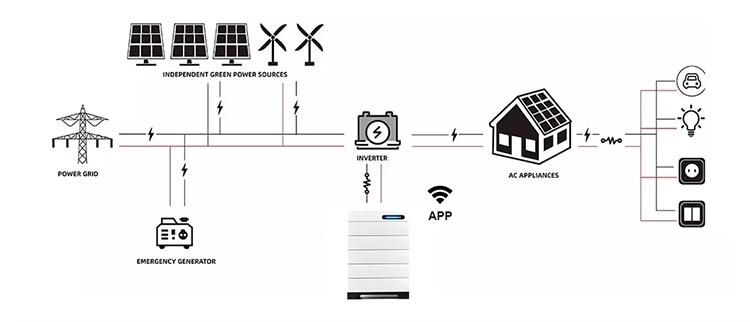
How Does a Stackable High-Voltage Battery Work in a Real System?
A real product example helps show how voltage architecture connects to modular expansion. At Sunway, we provide residential, commercial and industrial, and utility energy storage systems, while the battery architecture changes with project scale, power requirements, and inverter design.
The Stackable High-Voltage ESS uses modular LFP batteries in a stackable high-voltage architecture. Each battery module provides 5 kWh of capacity at 51.2 V and 100 Ah. Up to ten compatible modules can be combined in the current system configuration, bringing total storage capacity to 50 kWh. Battery supervision is handled through the BMS, with CAN and RS485 available for communication with compatible equipment. The platform uses natural cooling and is specified for 6,000 cycles.
The modular design demonstrates how compatible battery units can be assembled into a higher-voltage storage platform while maintaining centralized battery supervision and inverter communication. It does not mean that high voltage is always the better choice.
The correct inverter, allowed module count, charging and discharge limits, installation environment, and operating mode still need to match the project.
Choose the Architecture Before You Choose the Battery Quantity
The most reliable way to compare high-voltage vs low-voltage battery systems is to begin with the required power, energy capacity, inverter platform, and expansion plan. Voltage then becomes part of the architecture instead of a marketing specification considered on its own.
Share your inverter model, target storage capacity, backup loads, PV power, grid configuration, and future expansion plan with us. Review your battery and inverter configuration before fixing the battery voltage or module count.
FAQ
Q: Is a high-voltage battery always more efficient than a low-voltage battery?
A: No. Higher voltage generally reduces current for the same power and can reduce resistive losses in parts of the DC circuit. Overall efficiency still depends on the battery, inverter, wiring, conversion stages, temperature, and operating conditions.
Q: Can a high-voltage battery work with any solar inverter?
A: No. Battery inverter compatibility requires matching the inverter’s battery voltage range, charge and discharge current limits, supported BMS communication, permitted module configuration, firmware, and operating modes. Similar nominal voltage alone does not confirm compatibility.
Q: Can I expand a solar battery system later?
A: Often yes, if the system was designed for modular expansion. The permitted module count, series or parallel architecture, BMS limits, inverter range, communication setup, protection, and battery version should all be confirmed before adding capacity.