

How Do SOC and Depth of Discharge Affect Usable Battery Energy?
Time : Sep 21, 2026 View : 186
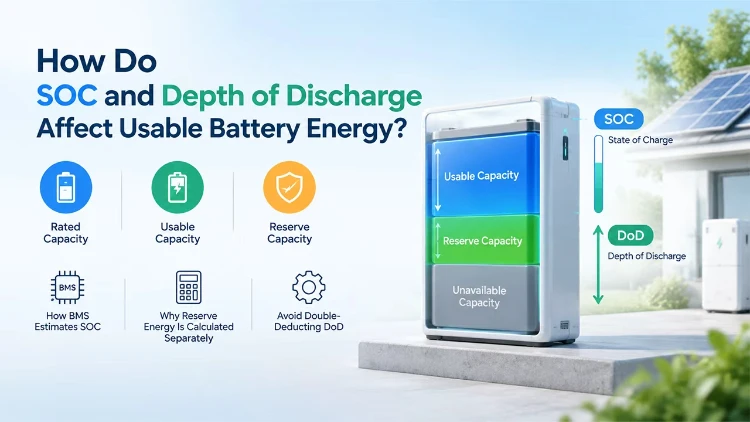
A battery marked 10 kWh does not necessarily make all 10 kWh available every time it discharges. The usable amount depends on the allowed state-of-charge window, depth of discharge, reserve settings, battery condition, and the limits enforced by the battery management system.
That distinction matters in battery storage because rated capacity, usable energy, and energy reserved for backup are not the same value. A practical comparison starts by separating SOC, DoD, and reserve instead of treating the nameplate capacity as fully available energy.
What Is State of Charge in a Battery?
State of charge, or SOC, describes how much charge remains in a battery relative to its available capacity at that moment. A battery at 100% SOC is near the upper operating limit defined by the system. At 50% SOC, roughly half of that available charge remains. At a low SOC, the BMS may restrict further discharge before the cells reach an unsafe limit.
SOC is an estimate rather than a value that a sensor reads directly. The BMS uses measured current, voltage, temperature, battery models, and calibration data to estimate it. That estimate can also change as the battery ages or operating conditions move away from the conditions used for calibration.
SOC Is Different From Battery Health
SOC answers “how much charge is left now?” State of health, or SOH, addresses a different question: how the battery’s present condition compares with its earlier or rated condition. A battery can show a high SOC while still having less total capacity than it had when new.
Keeping those two ideas separate prevents a common error when reading monitoring data. A full battery is not necessarily a battery with its original energy capacity.
What Does Depth of Discharge Mean?
Depth of discharge, or DoD, describes how much of the battery’s capacity has been used during a discharge window. In a simplified example, a battery that starts at 100% SOC and stops at 20% SOC has used an 80% depth of discharge.
SOC and DoD therefore describe the operating window from different directions. SOC focuses on what remains at a given moment; DoD focuses on how much has been taken out across the discharge interval.
The distinction becomes more important in real systems that do not always start at 100% SOC. A battery may begin an evening discharge at 85%, stop at 25%, and still have reserve left for backup. In that case, the operating window matters more than a simple “100 minus SOC” shortcut.
Why Is Rated Battery Capacity Different From Usable Energy?
Rated or nominal energy describes the battery’s labeled storage capacity under defined conditions. It is a useful reference, but it does not mean the entire number is available for every operating objective.
The BMS normally keeps the cells inside a permitted voltage and SOC range. Some energy may also be held back for backup, fault protection, or a later operating event. Temperature, current, aging, and battery condition can further change how much energy is practically available at a given time. Battery capacity itself is measured under specified conditions, so actual available capacity can differ as operating conditions change.
This is why two products with similar rated kWh can provide different usable energy. A specification that gives both rated energy and usable energy provides a clearer comparison than rated capacity alone.
How Do You Calculate Usable Battery Capacity?
For a simple case where rated energy is the starting value and the stated DoD represents the permitted discharge window:
Usable energy ≈ Rated energy × allowed DoD
A 100 kWh battery operating at an allowed 80% DoD would therefore have an illustrative 80 kWh discharge window.
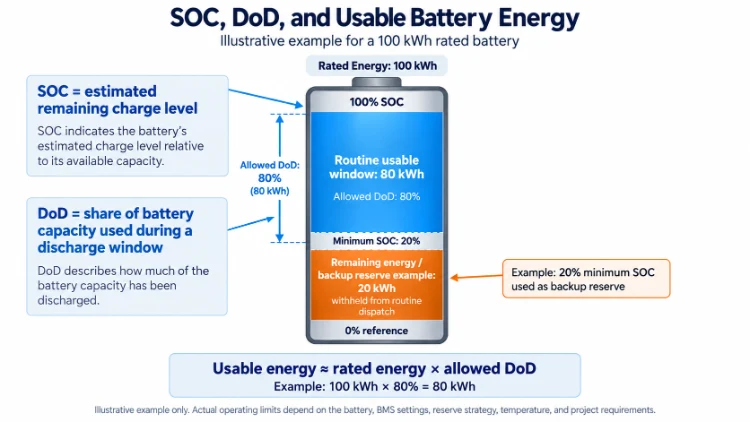
The formula should not be applied twice. If a battery is already specified as having 90 kWh of usable energy, multiplying that 90 kWh by the DoD again would understate the available window.
It is also important to distinguish battery-side usable energy from AC energy delivered to a load. Inverter losses, wiring losses, auxiliary consumption, temperature, and other operating conditions can affect delivered energy. Those factors belong in the system-performance calculation rather than being mixed into the DoD definition itself.
Why Should Backup Reserve Be Kept Separate From DoD?
A system can have usable battery capacity and still reserve part of it for another purpose. This matters in homes and commercial sites where the same battery handles daily cycling and outage backup.
Suppose a 100 kWh battery has a 90 kWh usable operating window, but the project requires 20 kWh to remain available for critical loads. The full 90 kWh should not be treated as available for tariff shifting or routine peak shaving. Only the portion not reserved for backup can be scheduled for those tasks.
Usable energy is therefore not always the same as dispatchable energy for every objective.
The reserve should be based on the actual backup load and required duration, not on a generic percentage applied to every project.
Does a Higher DoD Always Mean More Useful Energy?
A wider DoD window can release more energy per cycle. For the same rated battery, an allowed 90% DoD provides a larger discharge window than 60% DoD.
That does not make the highest possible DoD automatically preferable. Battery life depends on several interacting factors, including chemistry, temperature, charge and discharge rate, time spent at high or low SOC, and the cycling profile. Cycle-life figures also need to be considered together with their test conditions rather than treated as stand-alone numbers.
For buyers, the practical question is whether the allowed DoD provides enough useful energy while still fitting the battery’s control strategy and expected duty cycle.
How Does the BMS Estimate and Protect SOC?
The BMS continuously tracks battery conditions so that charging and discharging stay within defined limits. Voltage, current, temperature, and accumulated charge data feed the SOC estimate, while protection logic can reduce or stop current when operating limits are reached.
The system may also use SOC thresholds to preserve a lower reserve, prevent excessive discharge, or keep headroom for later charging. These controls explain why the percentage shown on a screen is part of an active management strategy, not simply a fuel gauge.
For solar storage, the BMS also has to communicate correctly with the inverter or system controller. A sound configuration uses battery status and protection limits when deciding when to charge, discharge, or hold reserve.
What Should Buyers Check in a Battery Specification?
A battery specification should separate the values that describe stored energy from the values that describe the operating window. Buyers should check rated energy, usable energy, allowed DoD, SOC limits, cycle-life test conditions, BMS communication, and any stated reserve or protection settings.
For smaller home projects, the wider residential ESS range provides context for how battery capacity, inverter choice, and system architecture vary across different storage requirements.
|
Specification |
What It Tells the Buyer |
|
Rated energy |
Labeled battery energy under defined conditions |
|
Usable energy |
Energy available within the permitted operating window |
|
SOC range |
Upper and lower operating limits |
|
DoD |
Share of capacity permitted for discharge |
|
Backup reserve |
Energy intentionally held for resilience |
|
Cycle condition |
Test context behind lifecycle claims |
|
SOC accuracy |
How closely the BMS estimates charge level |
The most important point is to compare like with like. A rated-energy figure should not be compared directly with another product’s usable-energy figure, and a cycle-life number has limited meaning if its test conditions are missing.
What Do SOC and DoD Look Like in a Real Battery System?

At Sunway, we work with different battery configurations for residential, commercial, and larger energy storage applications. In each case, rated capacity, usable energy, BMS limits, and the intended operating window need to be considered separately.
The SUNWAY 14.33kWh Home Energy Storage Battery provides a clear example. The LiFePO4 battery operates at 51.2 V with a nominal capacity of 280 Ah, giving 14,336 Wh of rated energy. Its specified usable capacity is 12,902.4 Wh, based on a 90% DoD operating window. The battery also supports RS485 and CAN communication and is rated for more than 6,000 cycles at 90% DoD.
The relationship between the two capacity figures is straightforward:
14.336 kWh rated energy × 90% DoD = 12.9024 kWh usable energy
This calculation also shows why DoD should not be deducted twice. The 12.9024 kWh figure is already the usable capacity after the specified 90% DoD has been applied. Multiplying that value by 90% again would incorrectly reduce the available energy a second time.
Actual energy available at a particular moment still depends on the current SOC, BMS limits, battery condition, temperature, and any reserve required for backup. For that reason, the usable-capacity figure should be treated as the defined operating window rather than a guarantee that the full amount will always be available for every task.
Know How Much Battery Energy Is Actually Available
Battery capacity becomes useful only when the operating window matches the load. Before choosing a storage size, define the required energy, minimum reserve, backup duration, inverter power, and expected daily cycling.
Share those project inputs with us to review your usable battery energy and reserve requirements before fixing the final capacity. The objective is to match rated energy, usable energy, and reserve to the way the battery will actually operate.
For typical household daily cycling with backup reserve, the 14.33 kWh wall-mounted model is a common starting point; projects that need more capacity generally move to the Racked Lithium Battery or Wall Mounted Lithium Battery series.
FAQs
Q: Is 90% DoD the same as 10% SOC?
A: They can describe the same end point in a simplified cycle that starts at 100% SOC and ends at 10% SOC. They are not identical concepts. SOC describes the battery’s current charge level, while DoD describes how much capacity has been used across a discharge interval.
Q: How do I calculate usable battery capacity from DoD?
A: When rated energy is the starting value, a simple estimate is rated energy multiplied by the allowed DoD. For example, 10 kWh × 80% gives an 8 kWh discharge window. Do not apply DoD again if usable energy is already stated in the specification.
Q: Why does a battery keep some capacity in reserve?
A: Reserve can protect critical loads, maintain a minimum operating SOC, or support the battery’s protection strategy. The required reserve depends on the project objective and should be kept separate from energy allocated to routine cycling.