

AC-Coupled vs DC-Coupled Battery Storage Explained
Time : Oct 19, 2026 View : 414
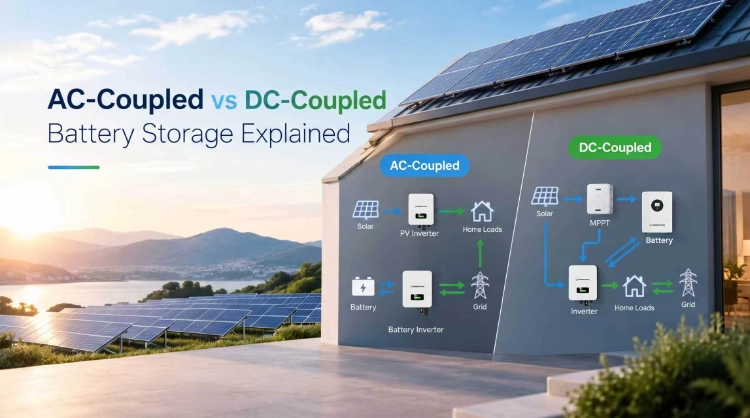
An existing rooftop solar installation may be able to add battery storage while retaining its PV inverter. A new building, however, can plan the solar array, battery, and inverter together from the beginning. Both approaches can store solar electricity, but the conversion paths are different. That is the practical distinction between AC-coupled and DC-coupled battery storage.
AC coupling brings solar generation and battery storage together on the AC side. DC coupling coordinates the two on the DC side before electricity reaches the main AC supply. Neither choice automatically provides better backup, lower cost, or higher overall efficiency. The existing inverter and charging requirements often settle the question.
What Is the Difference Between AC and DC Coupling?
Coupling describes where solar generation and battery storage connect electrically. It is separate from battery voltage and whether the site operates on-grid or off-grid.
In an AC-coupled layout, the PV inverter feeds an AC distribution bus. The battery has its own bidirectional inverter or power conversion system (PCS), also connected to that bus. Each system converts power independently.
A DC-coupled layout brings PV and battery connections into a shared DC-side architecture. A hybrid inverter typically coordinates the sources, with suitable DC/DC conversion and battery controls where required. The inverter then supplies AC power to loads or the grid.
How Does AC-Coupled Battery Storage Work?
An AC-coupled system gives the PV array and battery separate routes to the AC bus.
Solar Electricity Passes Through the PV Inverter
During ordinary solar generation, PV modules produce DC electricity. The existing PV inverter converts it to AC for local loads or permitted grid export. Adding storage does not necessarily change that original path.
When surplus solar charges the battery, electricity typically follows a longer route: PV DC to inverter AC, then through the battery PCS back to DC. The battery management system (BMS) sets charging limits.
Battery Discharge Uses a Separate Converter
When stored energy is needed, the battery PCS changes battery DC into AC. Loads then use that power within system limits. Separate converters can give installers flexibility in equipment placement and future upgrades, though monitoring and export controls must coordinate the two systems.
How Does DC-Coupled Battery Storage Work?
In DC-coupled solar battery storage, the solar and battery circuits are coordinated before the main AC conversion point. A shared hybrid inverter is one common arrangement, but the precise topology varies by equipment.
Solar Can Charge the Battery on the DC Side
Solar DC can pass through a suitable DC/DC stage and charge the battery without first becoming AC. This avoids the AC-to-DC reconversion found in a typical AC-coupled solar-charging route. It does not mean the PV modules connect directly to battery terminals. MPPT control, voltage matching, current protection, and BMS communication remain necessary.
The Main Inverter Supplies AC Loads
When the site needs electricity, stored battery energy travels through the system’s power-conversion stages to the shared inverter’s AC output. The inverter rating and DC voltage ranges place limits on how much solar and battery power can be handled at once. Stored energy cannot support loads exceeding inverter power limits.
Is DC-Coupled Battery Storage More Efficient?
For solar-to-battery charging, DC coupling can avoid some conversion steps. That may improve the energy retained from surplus PV, particularly where a shared inverter can also capture generation that would otherwise be clipped. It is not a promise of higher efficiency under every operating condition.
If the battery is charged from the grid, or if different inverters operate at different load levels, the comparison changes. DC/DC losses, inverter efficiency curves, wiring, standby power, and thermal equipment affect both arrangements. Compare the same source-to-load energy path and operating conditions.
At utility scale, DC coupling may also recover PV energy that a shared inverter would otherwise clip, but additional DC/DC conversion and more complex controls bring their own costs (National Laboratory of the Rockies, 2025). That does not establish a universal efficiency advantage for residential systems.
Which Coupling Method Works Better With Existing Solar?
An established solar installation is often the deciding factor. Replacing a healthy PV inverter solely to add storage can create work that an AC-coupled retrofit might avoid.
AC Coupling Often Preserves the Existing PV Equipment
An installer may retain the grid-tied PV inverter and add battery conversion, metering, protection, and controls on the AC side. That can simplify some retrofits, although inverter compatibility and local interconnection rules still need checking. Storage may also affect existing export restrictions.
PV equipment can be assessed separately from battery expansion. This matters when replacing the inverter would disturb warranties or approved wiring.
DC Coupling Often Fits New Integrated Projects
A new solar-plus-storage project can select PV strings, battery voltage, hybrid inverter, and controls as one package. That makes DC coupling a natural candidate, especially when the same equipment is intended to manage daytime solar, evening loads, and battery reserve.
For an existing site, it can also make sense if the PV inverter already needs replacement. Either approach requires site checks.
Does Coupling Determine Backup Power During an Outage?
No. An AC-coupled battery can provide backup when the system includes a suitable grid-forming inverter, isolation equipment, protected-load circuits, and coordinated controls. A DC-coupled battery also needs these functions if it is to continue operating while the utility is down.
A conventional grid-following solar inverter normally disconnects when the grid fails. In an AC-coupled backup arrangement, additional control may be needed to keep PV production compatible with the battery-formed island and prevent overproduction. In a hybrid DC-coupled system, backup output is still limited by inverter power, stored energy, transfer arrangements, and protected loads.
Compare this with off-grid, grid-tied, and hybrid energy storage systems. Those labels describe the relationship with the utility; coupling describes the electrical connection between solar and storage.
AC vs DC Coupling: What Should Buyers Compare?
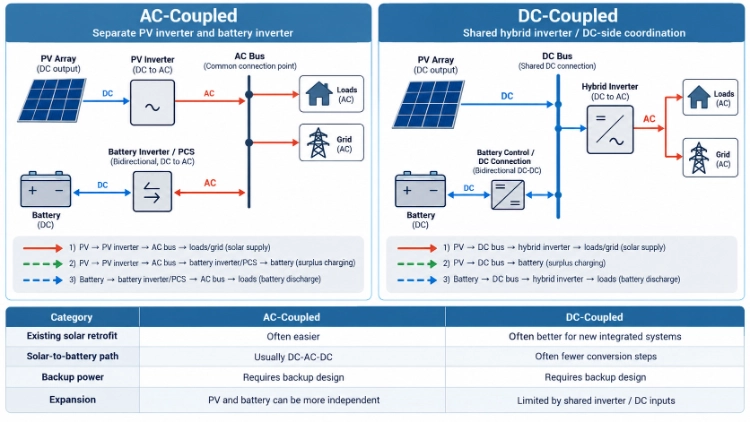
Neither configuration wins every project. The useful comparison is based on equipment already installed and the specific charging and discharge paths.
|
Decision factor |
AC-coupled storage |
DC-coupled storage |
|
Connection point |
Shared AC bus |
Shared DC-side architecture |
|
Solar-to-battery charging |
Usually DC–AC–DC |
May charge through DC/DC before AC conversion |
|
Existing solar retrofit |
Often retains the PV inverter |
May require inverter or DC-side redesign |
|
New integrated installation |
Viable with separate conversion equipment |
Often suits a planned hybrid inverter package |
|
Expansion |
PV and battery sides may be upgraded separately |
Subject to shared inverter and DC input limits |
|
Outage support |
Requires approved backup architecture |
Also requires approved backup architecture |
For buyers comparing residential configurations, the residential energy storage system range helps place battery and inverter choices within the wider project scope. A category or voltage label alone is not enough to confirm coupling or backup capability.
What Should Be Checked Before Choosing a System?
Begin with the existing PV inverter model, grid connection, and any plan to replace equipment. Then confirm the intended charging source: surplus solar, grid electricity, or both. The answer affects converter selection and the way efficiency should be assessed.
In the technical review, check PV input and MPPT ranges, battery operating voltage, charge/discharge limits, supported BMS communication, inverter power, metering, export control, and permitted expansion. For AC retrofits, the interaction between existing PV controls and the battery PCS deserves specific attention. For DC coupling, shared input limits and the ability to coordinate PV and battery operation are central.
Backup is a separate acceptance item. Specify the critical-load circuit, transfer equipment, islanding behavior, maximum backup power, and usable reserve. Ask for a single-line diagram and a clear account of what remains energized during an outage rather than relying on the word “hybrid” alone.
How Does an Integrated Solar Storage System Fit?
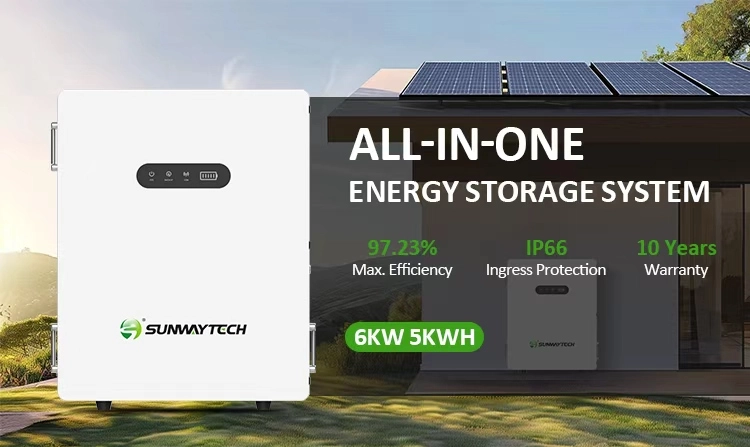
A compact hybrid platform illustrates how PV and battery inputs can be brought together without installing separate solar and battery inverter packages. It is one DC-coupled architecture, not a universal configuration.
At Sunway, the SUNWAY 5kWh All-in-One Home ESS combines a 6kW single-phase hybrid inverter with a 5.12kWh lithium battery. The platform includes two MPPT trackers, a battery interface in the 40–60V operating range, BMS communication through CAN, and Wi-Fi monitoring. PV and battery operation are managed within the integrated inverter architecture.
The 6kW inverter rating does not guarantee 6kW of sustained battery-only output. Battery-side current limits, state of charge, and operating mode still define the available contribution. PV and load compatibility still matter.
Map the Energy Path Before Choosing the Battery
A sound solar battery design begins with a diagram of where power comes from, how it reaches storage, and where it must go afterward. That exercise often identifies whether the current PV inverter can stay or whether a new hybrid architecture is worth considering.
Share the existing inverter model, PV array details, battery target, grid requirements, and backup loads with us. We can help review your solar storage architecture before the equipment configuration is finalized.
FAQ
Q: Is AC-coupled battery storage better for existing solar panels?
A: Often, especially when the existing PV inverter is still serviceable. AC coupling may allow storage to be added without replacing that inverter. The final choice depends on compatible controls, connection approval, installation costs, and backup requirements.
Q: Does DC coupling always make solar battery storage more efficient?
A: No. DC coupling may avoid extra conversion during solar-to-battery charging, but grid charging and battery discharge follow different paths. Converter efficiency, operating load, wiring, and auxiliary power determine the total result.
Q: Can both AC- and DC-coupled batteries supply backup power?
A: Yes, when the complete system is designed for island operation. Battery capacity alone is insufficient. Grid isolation, grid-forming capability, switching, inverter limits, and a protected-load circuit must be confirmed for either architecture.