

Can Battery Storage Reduce EV Charging Grid Upgrade Costs?
Time : Oct 12, 2026 عدد المشاهدات: 116
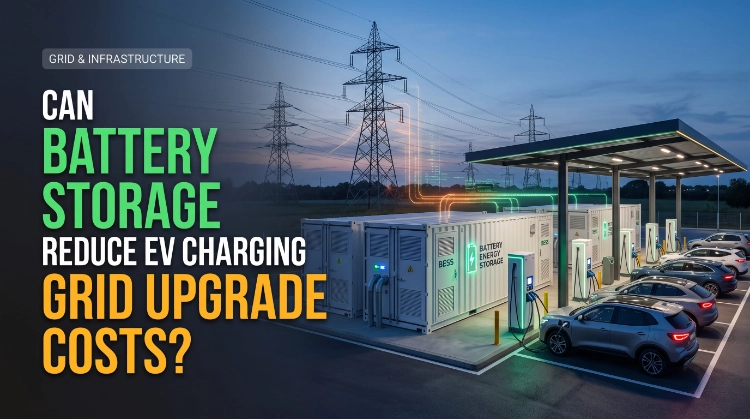
Battery storage can reduce or defer EV charging grid upgrade costs when high charging demand arrives in short peaks rather than continuing throughout the day. A battery supplies the power the existing connection cannot provide during those peaks, then recharges when charging demand falls. At some sites, that makes DC fast charging possible without an immediate utility upgrade.
It cannot replace inadequate long-term supply. What matters is how much grid headroom remains and whether the battery can recover between peaks.
Why Do EV Fast Chargers Sometimes Require Grid Upgrades?
A fast charger’s rated output does not establish what the site can draw from the grid. That available capacity must serve both existing loads and chargers.
Existing Loads Reduce Grid Headroom
At a shopping center, air conditioning, lighting, and refrigeration may already be drawing significant power when vehicles arrive. Even where a utility service has a stated capacity, transformer ratings, switchgear, cables, contractual limits, or utility approval can further restrict charging. Check permissible import at the connection point, not monthly bills alone.
Short Charging Peaks Can Drive Expensive Work
Several vehicles arriving close together can push demand well above the site’s spare capacity. Chargers may share available power, but operators often want to maintain a useful service level during these peaks. Increasing grid capacity could require a larger transformer, replacement distribution equipment, or upstream utility work. Costs differ between sites.
How Does Battery-Buffered Fast Charging Reduce Grid Demand?
In battery-buffered fast charging, the grid continues to provide a limited but dependable supply. Battery storage contributes additional power for periods when the chargers need more than that connection can deliver.
Cover the Gap During a Charging Peak
When charging demand approaches the approved import limit, the energy management system (EMS) can request battery discharge. The battery management system (BMS), inverter or converter, and state of charge (SOC) determine what is available. Power from storage makes up some of the difference without requiring the utility connection to deliver the full peak.
There is a limit. At minimum SOC or a discharge limit, the station may need to reduce charger power or prioritize sessions.
Restore Energy Between Sessions
Lower-demand periods create an opportunity to recharge from spare grid capacity or available solar generation. The recovery interval matters. Short sessions spaced throughout the day are easier to buffer than hours of queued high-power charging.
Storage shifts grid demand; it does not create energy.
How Much Grid Power Can Battery Storage Offset During Charging Peaks?
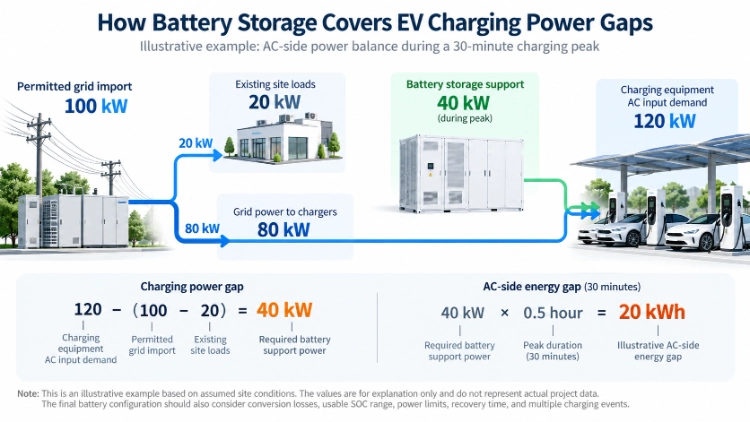
The useful calculation starts with site power balance. The following hypothetical example uses AC-equivalent site demand, not a DC charger nameplate rating, to avoid mixing charger output with grid-side input.
|
Illustrative site condition |
Value |
|
Permitted grid import |
100 kW |
|
Existing site demand |
20 kW |
|
Charging equipment AC input demand |
120 kW |
|
Charging peak duration |
30 minutes |
With 20 kW already committed to the building, only 80 kW of grid power remains for charging. If the charging equipment needs 120 kW AC input, storage must contribute the equivalent of 40 kW at the site bus, assuming no solar contribution.
Charging power gap = 120 − (100 − 20) = 40 kW
AC-side energy gap = 40 kW × 0.5 hour = 20 kWh
That 20 kWh is the energy required for this one event at the AC bus. It is not the required battery nameplate capacity. Losses, SOC limits, backup reserve, power limits, and battery condition need separate allowances.
Repeated peaks matter. Another group of vehicles can drain the battery before it recovers from the first event.
When Is Battery Storage Not Enough to Avoid an Upgrade?
Battery buffering makes most sense where the existing grid can supply enough energy over time, even if its instantaneous power falls short during busy periods.
High Demand Continues for Too Long
A battery cannot cover a daily energy deficit indefinitely. If the combined grid supply and on-site generation cannot replenish the energy dispensed to vehicles, increasing the battery capacity only delays depletion. A larger connection, additional generation, or limits on charging throughput may still be necessary.
Power (kW) determines the shortfall; energy (kWh) determines its duration.
There Is Too Little Time to Recharge
Back-to-back charging sessions can leave little headroom for battery recovery. Once SOC reaches its lower operating limit, chargers may need to share reduced power. A minimum reserve kept for backup leaves less energy for everyday buffering. Expansion plans matter too, since today’s occasional peak may become tomorrow’s sustained load.
Is Battery Storage Cheaper Than Upgrading the Grid?
Sometimes. The strongest case occurs when a substantial grid upgrade would serve a charging peak that rarely lasts long. Battery storage may offer an interim or longer-term alternative, but its installed cost and ongoing operating demands must be compared with utility work.
One rural highway charging project assessed by the U.S. National Renewable Energy Laboratory (NREL) illustrates the difference. The local utility estimated a $3 million substation upgrade to support a proposed 600 kW DC fast-charging installation. For that particular site, NREL found that battery-buffered charging had the potential to reduce total capital costs by 65% and bring deployment forward by two to five years. Those were project-specific estimates, not savings guaranteed for other charging stations. The NREL battery-buffered fast charging case study provides the comparison and its assumptions.
The financial review must still include batteries, conversion equipment, installation, maintenance, electricity tariffs, losses, replacement planning, and any remaining utility work. Charging utilization and future growth can change the result. At a heavily used station, permanent grid reinforcement may be more economical. Other sites may favor storage first and upgrade later.
What Site Data Should Be Reviewed Before Choosing Storage?
Monthly electricity totals cannot show whether a battery will recharge between vehicles. A credible design needs time-based measurements and charging-demand estimates.
Record the approved grid import limit, building load curve, transformer and switchgear constraints, and current or projected vehicle sessions. Include how many chargers might operate simultaneously, charging-session duration, vehicle acceptance characteristics, and seasonal patterns. Where photovoltaic (PV) generation is planned, use an hourly output profile rather than an annual production figure.
Test the First Hour and the Design Day
A First Hour test asks whether the station can serve a burst of concurrent charging demand starting with the battery fully charged. A Design Day test examines a suitably demanding operating day and whether charging can continue without exhausting the stored energy.
The second test is often the harder one. A station might serve its first arrivals successfully, then lose charging power after repeated sessions. The chosen Design Day should reflect the site’s projected vehicle traffic, not an arbitrary number of sessions.
Check Operating Controls and Future Expansion
Battery discharge limits, minimum SOC, charger power-sharing rules, grid-import measurement, and control response must work together. A design that looks sufficient on paper can still breach an import target if the controls respond poorly to changing site loads. Planned additional charging guns should be included in the longer-term review.
ال PV ESS charging system range provides system options once the power gap and operating requirements are established.
What Does an Integrated Battery-Buffered Charging System Offer?
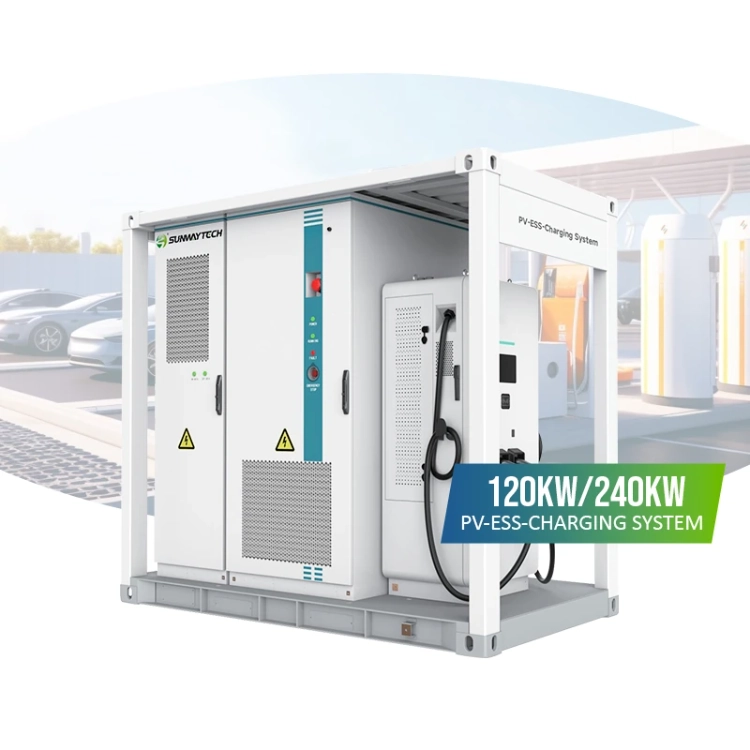
A combined solar-storage-charging installation brings batteries, charging equipment, controls, and PV access into one system. This can reduce the number of interfaces an installer must coordinate, although local connection approval, electrical protection, and commissioning are still required.
At Sunway, the نظام صنواي المتكامل للطاقة الشمسية الكهروضوئية وتخزين الطاقة وشحن السيارات offers two configurations. The SW120kW241kWh-PSC pairs 241.15 kWh of LFP storage with 120 kW of rated DC charging power and two guns. The SW240kW482kWh-PSC combines 482.3 kWh of storage with 240 kW and four guns. Both configurations feature intelligent liquid cooling, a 0.5C battery charge/discharge rating, DC PV connection, and EMS-based demand management.
These ratings describe the equipment, not the grid capacity a site can automatically avoid upgrading. Simultaneous charging output, available battery support, and import reduction still depend on site loads, SOC, and approved operating limits.
Check Grid Headroom Before Investing in Fast Chargers
The first decision is not how many battery cabinets to order. It is whether the gap between available grid power and expected charging demand is brief enough for storage to handle repeatedly.
Share the approved grid capacity, measured site loads, charger power, expected arrival patterns, and PV plans with us. We can help review your EV charging power gap and project requirements before equipment quantities are fixed. A viable configuration needs to manage the first busy hour and recover for the next one.
For the wider system context, how a solar EV charging station with battery storage works explains how solar generation, batteries, grid supply, and chargers interact.
الأسئلة الشائعة
Q: Can battery storage completely eliminate an EV charging grid upgrade?
A: In some projects, yes. Short charging peaks can be buffered when the battery has enough power and usable energy, plus time to recharge. Where sustained demand exceeds the electricity available over the day, storage alone cannot replace the additional supply or operational changes required.
Q: How much grid power does a DC fast charging station need?
A: It depends on the charging equipment’s AC input, simultaneous sessions, other site loads, and import restrictions. Charger rated DC output is not identical to grid-side electrical input. Vehicle charging profiles and battery contribution should be assessed before deciding the connection capacity.
Q: What happens when a charging-station battery runs low during peak demand?
A: The EMS may reduce charging power, prioritize sessions, or use additional grid power if the connection permits. Available options depend on the BMS minimum SOC, converter limits, charger controls, and site operating policy.