

How to Choose the Best 100kW Liquid Cooled Industrial Energy Storage Systems for Heavy Manufacturing?
Time : Apr 20, 2026 View : 233

Heavy manufacturing plants rarely shop for an industrial energy storage system because storage is fashionable. They do it because grid volatility interrupts production, short peak loads inflate electricity bills, and conventional power infrastructure is often too rigid for modern factory schedules. In 2026, the commercial and industrial energy storage system market is moving toward projects that can cut demand charges, support backup power for manufacturing, and work smoothly with onsite solar and plant-level controls. Europe’s storage expansion has accelerated, and industrial and commercial energy storage continues to grow as companies look for more flexible energy management.
At Sunway, we approach that problem from the plant floor rather than the brochure. Founded in 2017, the company has built product lines across residential, commercial, and utility-scale storage, and the core C&I category is positioned around peak shaving, demand management, and improved energy efficiency. That makes heavy manufacturing a practical fit for this discussion rather than a forced marketing scenario.
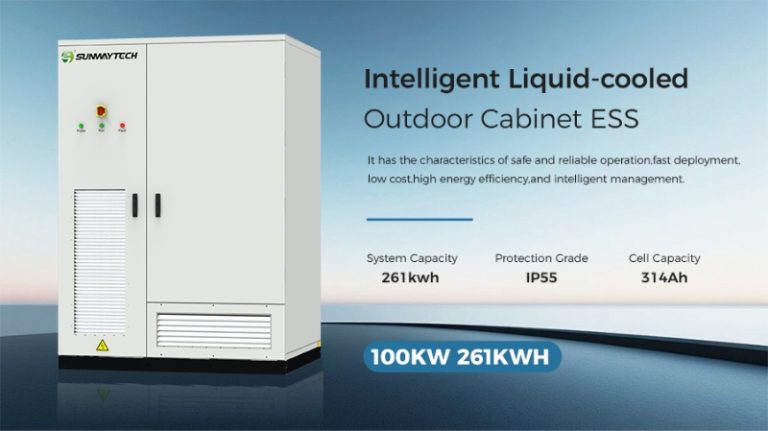
For factories weighing a 100kW liquid-cooled industrial energy storage system, the selection process should start with operating conditions, not slogans. The right unit must match real load peaks, shift energy economically, maintain stable temperature control, protect critical equipment, and leave room for future expansion. A good reference point is the 100kW 261kWh liquid-cooled ESS, an outdoor integrated system built for commercial and industrial energy applications with lithium iron phosphate battery technology, modular PCS architecture, intelligent energy management, and comprehensive safety controls.
Why Heavy Manufacturing Is Moving Toward 100kW-Class Liquid Cooled ESS
Heavy manufacturing energy storage projects are usually driven by four recurring issues. The first is peak shaving. A plant may run stable average loads most of the day, then spike sharply when compressors, cutting lines, presses, or auxiliary systems start at the same time. The second is demand charge management, where a short burst of power can affect the monthly bill out of proportion to its actual duration. The third is backup power for manufacturing, especially for control systems, precision machinery, and intermediate production stages that cannot tolerate abrupt shutdowns. The fourth is power quality, since voltage sag, swell, and flicker can shorten equipment life and disrupt process stability.
A commercial and industrial energy storage system is valuable here because it can store lower-cost electricity, discharge during high-tariff periods, support critical loads during outages, and improve the self-use rate of onsite renewable generation. These are not abstract benefits. They are the reasons industrial users adopt an industrial battery energy storage system in metallurgy, manufacturing, chemical processing, industrial parks, and microgrid projects.
Start with the Load Profile Before You Compare Cabinets
Many buyers look at kWh first because storage capacity feels easy to compare. In heavy manufacturing, that is often the wrong starting point. Power determines whether the system can handle real events such as motor starts, synchronized process loads, and short demand spikes. Energy determines how long the system can sustain the required output. A 100kW liquid-cooled industrial energy storage system should therefore be evaluated against both the plant’s maximum demand and the duration of the problem being solved. Peak shaving over one or two hours, backup support for critical process loads, and solar shifting all require different dispatch patterns.
Why 100kW / 261kWh Is a Practical Ratio
For many medium-load industrial sites, a 100kW-class system with 261kWh storage offers a balanced structure. It is large enough to support meaningful peak shaving and load shifting, but still compact enough for faster deployment than multi-container utility projects. The unit discussed here combines 261kWh battery capacity with 832V rated voltage, a 728V to 936V battery voltage range, 314Ah cell capacity, and up to 125kW AC output, which gives it relevance for factories seeking a factory energy storage cabinet rather than a grid-scale buildout.
Why Liquid Cooling Matters in Heavy Manufacturing
A liquid-cooled ESS is especially relevant when the installation environment is demanding, and the charging-discharging cycle is frequent. Heavy manufacturing facilities often operate in warm yards, dense utility areas, or enclosed service zones where thermal stability affects battery performance and lifecycle. A system that controls battery temperature precisely can support more consistent operation, reduce stress across cells, and improve long-term reliability.
Fit for Harsh Outdoor Conditions
This is where a liquid-cooled outdoor energy storage cabinet has a clear operational advantage. The system in focus uses intelligent liquid cooling, supports ambient temperatures from -25°C to +60°C with derating above 45°C, and is housed in an IP55-rated enclosure designed for outdoor installation. For manufacturers that cannot dedicate conditioned indoor space to storage, that matters as much as nameplate capacity. The enclosure also supports 0 to 95% relative humidity without condensation, less than 78dB noise, and operation up to 3000 meters with derating above 2000 meters.
Battery Chemistry, Safety, and Lifecycle Should Be Evaluated Together
Heavy manufacturing buyers rarely need the most aggressive chemistry headline. They need a safe LFP energy storage system that performs predictably under repetitive industrial duty. Lithium iron phosphate remains a strong fit because it offers stable thermal behavior, long service life, and broad acceptance in commercial and industrial storage projects. In practical selection work, the question is not only whether the chemistry is LFP. It is whether the whole cabinet architecture, control layer, and cooling strategy allow that chemistry to perform consistently over years of operation.
The unit discussed here uses lithium iron phosphate batteries in a 1P52S5S arrangement, with maximum charge and discharge current at 157A and maximum charging and discharging power listed at 0.5P. Those figures place it in the category of an industrial energy storage system designed for stable commercial cycling rather than speculative oversizing.
Evaluate the Whole System Architecture, Not Just the Battery Pack
An industrial battery energy storage system for heavy manufacturing should be judged as a system, not as a battery box with extra labels attached. The value of an all-in-one cabinet comes from integrated control and lower project complexity. In this case, the cabinet combines lithium iron phosphate batteries, modular PCS, intelligent EMS and BMS, power distribution, fire protection, and environmental control into one outdoor package. That architecture is much closer to what factories need in practice because it reduces coordination across separate subsystems and simplifies commissioning.
Modular PCS and Front Maintenance Support Real Operations
Modular PCS matters because industrial users do not all run the same load shape. A modular PCS configuration supports more precise matching for different application requirements, while also improving serviceability. Front maintenance is equally important. When a factory installs an outdoor energy storage cabinet against a wall, beside a substation, or in a constrained utility area, rear-access service quickly becomes a problem. This cabinet is built around modular PCS architecture and front-maintenance access, which reduces footprint pressure and keeps expansion or service work more manageable.
Electrical Compatibility and Power Quality Must Be Verified Early
A 100kW liquid-cooled industrial energy storage system can only create value if it integrates cleanly with the site. That means checking AC voltage, frequency, current, harmonics, power factor behavior, and communications before procurement. Here, the AC side is specified at 400V, 3W+N+PE, 50/60Hz, 180A rated AC current, with a total harmonic distortion of below 3 percent at rated power, and a voltage total harmonic distortion of below 3 percent under linear load. The power factor range extends from 1 leading to +1 lagging, which supports broader grid interaction and plant-side requirements.
For plants pairing storage with solar, PV-side compatibility is equally important. The system supports 100kW rated PV power, a 250 to 500V MPPT voltage range, 160A*2 PV maximum current, and 2 MPPT channels. That combination makes it a credible industrial solar storage system for factories trying to increase renewable self-consumption without jumping straight to a much larger project class.
Communications, Monitoring, and Expansion Strategy
A modern commercial and industrial energy storage system is also a control asset. If the plant cannot monitor alarms, view operating status, or integrate dispatch logic into broader energy management, the storage project loses much of its value. The cabinet here supports CAN and Ethernet/485 communication, which provides a practical foundation for BMS EMS integration and remote plant-level visibility.
That digital layer also supports a stronger lifecycle model. The service framework includes a self-developed cloud platform for remote monitoring, commissioning, and firmware upgrades, along with modular system configuration and project adaptation for local requirements.
Where This Type of ESS Fits Best in Heavy Manufacturing
Not every plant needs the same solution. A 100kW 261kWh ESS is most compelling where short peak events distort electricity bills, where critical loads need cleaner backup support, or where onsite solar and storage are being combined into a more resilient factory microgrid energy storage strategy. Metal processing, machining, continuous production workshops, and industrial parks are strong examples because they often combine high equipment sensitivity with compressed peak demand windows.
It also fits users who want more than emergency support. In a plant with renewable generation, the system can store surplus energy during the day and discharge it later when the plant still needs power, but solar output has dropped. In grid-constrained areas, it can reduce pressure on transformer upgrades. In facilities concerned with process stability, it can support cleaner power delivery and buffer sudden disturbances. That is why liquid-cooled ESS projects are increasingly tied to peak shaving, demand charge management, renewable integration, and backup power in one combined investment case.
Service Should Be Part of the Selection Decision
Technical selection is only one part of a successful industrial ESS project. Execution, commissioning, customization, and after-sales response affect long-term performance just as much. The service structure here covers flexible delivery and customization, seamless on-grid and off-grid operation, modular PCS configuration, a cloud platform for remote lifecycle support, and global after-sales support through overseas service centers. For B2B buyers, those points matter because the project does not end when the cabinet arrives on-site.
That is also why we recommend evaluating the service at the same time as electrical specifications. If the application involves heavy manufacturing, buyers should expect support with system matching, compliance alignment, expansion planning, and long-term operation. A technically sound product without a reliable service model can still become an expensive operational problem. If you want to assess site fit, project structure, or system sizing in more detail, you can contact us for the next step.
Conclusion
The best 100kW liquid-cooled industrial energy storage system for heavy manufacturing is not the one with the loudest claims. It is the one that matches load behavior, manages plant peaks economically, protects critical operations, fits the site environment, and remains serviceable as the facility grows. A liquid-cooled ESS with LFP chemistry, integrated control, modular PCS, strong communication architecture, and outdoor-ready protection is a practical direction for factories that want measurable gains rather than theoretical advantages. The 100kW 261kWh configuration discussed here is a strong example of that logic because it brings together the key elements that industrial buyers usually need in one cabinet.
FAQ
Q: Is a 100kW liquid-cooled industrial energy storage system suitable for every heavy manufacturing plant?
A: No. It is suitable when the plant’s peak load profile, backup scope, and operating schedule align with a 100kW-class power level and a 261kWh storage window. Some factories need a smaller system for demand charge management only, while others require a larger multi-unit solution.
Q: Why is liquid cooling preferred in many industrial battery energy storage system projects?
A: Liquid cooling supports tighter thermal control, which helps battery consistency, long-cycle operation, and outdoor performance in demanding industrial environments. It is especially useful where charging and discharging are frequent, or site temperatures vary significantly.
Q: What should buyers verify before choosing a commercial and industrial energy storage system for manufacturing?
A: Buyers should verify real load peaks, required discharge duration, AC and PV compatibility, communication interfaces, enclosure protection, maintenance access, expansion path, and service support. Those factors usually determine whether the project creates long-term value.