

Apartment Solar Guide: How to Choose the Best Plug-and-Play Balcony Energy Storage
Time : Apr 13, 2026 View : 753

Urban power infrastructure faces a rapidly compounding challenge. As metropolitan populations dense and electricity demand spikes, the limitations of traditional, centralized power grids become increasingly obvious. Historically, the renewable energy sector focused heavily on massive utility-scale solar farms or sprawling residential rooftop arrays. This development pattern effectively excluded millions of apartment tenants and high-rise condo owners from generating their own clean electricity. Meanwhile, retail utility rates continue a steady, unpredictable climb across global markets.
This economic reality forces city dwellers to find practical methods to offset their daily utility expenses. They require immediate, accessible green electricity for apartments. Addressing this exact hardware gap in the market, Sunway emerged with a clear engineering mandate. We design and manufacture home energy storage solutions mapped directly to the spatial and logistical constraints of modern city living.
Since our founding in 2017, we have committed our technical resources to democratizing power access. Generating sustainable electricity should not function as an exclusive privilege for those with suburban property. Instead, we focus on engineering hardware that transforms standard exterior walls, railings, and small terraces into highly active, independent micro-power plants. The transition toward decentralized urban power generation is no longer a future concept; it is an active, necessary shift in how cities manage their energy loads.
What Makes the Best Plug-and-Play Balcony Energy Storage?
Selecting reliable power generation equipment for an urban environment requires looking past the standard specifications found on traditional rooftop panels. A truly effective plug-and-play balcony energy storage setup must balance consistent energy yield, highly intelligent conversion mechanics, and absolute minimal deployment friction. This apartment solar guide outlines the critical technical parameters you must evaluate before installing any generation equipment within a restricted footprint.
Optimal Power Output for Urban Living
Determining the correct generation capacity dictates the overall success and safety of any urban solar project. Based on our extensive hardware testing and residential load analysis, a balcony solar system of 800W serves as the optimal configuration for the vast majority of apartment layouts. We engineered our systems around this specific rating deliberately.
The math behind this capacity makes practical sense. An 800-watt peak output safely offsets the continuous baseline electrical draw of common household appliances. This includes refrigerators, network routers, home automation hubs, and various standby consumer electronics. It covers the parasitic electrical loads that silently drive up monthly utility bills, all without risking an overload on standard residential wiring circuits.
More importantly, the 800W threshold frequently satisfies strict local grid regulations. Across numerous international jurisdictions, authorities permit grid-tied balcony solar installations up to this specific wattage limit without demanding complex building permits, grid injection approvals, or costly professional electrical certifications. Such regulatory alignment removes bureaucratic friction, making the adoption process straightforward and highly efficient for the end user.
High-Efficiency Conversion with MPPT Technology
Confined vertical spaces present unique environmental challenges that traditional ground-mount solar arrays never face. Apartment solar panels must deal with rapidly fluctuating light conditions, complex partial shading from neighboring architectural structures, and sudden weather shifts. To extract maximum yield in these sub-optimal conditions, the system’s inversion hardware must react instantly to environmental changes.
This specific operational requirement makes an MPPT technology solar inverter strictly necessary. Maximum Power Point Tracking (MPPT) relies on highly advanced mathematical control algorithms to sample and adjust the operating voltage and current of the connected photovoltaic modules in real time.
Our engineering data and established industry metrics confirm that systems utilizing active MPPT algorithms achieve a 10% to 20% efficiency increase over older, static inversion methods. By constantly locking onto the exact electrical sweet spot during environmental shifts, the controller ensures you capture the highest possible volume of energy during narrow, restricted sunlight windows. When a neighboring building casts a shadow across half of your balcony, the MPPT system recalculates the optimal voltage to keep the unshaded cells producing at their absolute maximum capacity.
True Convenience for Urban Residents
Modern residential power hardware must prioritize accessibility above all else. Conventional solar arrays require heavy structural engineering, invasive roof modifications, and highly specialized electrical labor. A genuinely functional plug-and-play balcony energy storage framework removes these traditional deployment barriers entirely.
We mapped our mechanical architecture specifically for non-invasive assembly. This enables a secure, highly reliable DIY balcony solar process. Users can mount the generation modules to standard railing structures using adjustable, high-strength metal brackets.
The electrical integration proves equally direct and removes the need for hired contractors. The output cable from the micro-inverter typically connects straight into an existing, standard household wall outlet. This immediate direct-to-grid connection means the generated alternating current instantly feeds into the apartment’s local circuit. It immediately begins offsetting concurrent household electricity consumption, delivering measurable financial value minutes after taking the equipment out of the box.
Spotlight: Micro Complete 800W Balcony Solar System
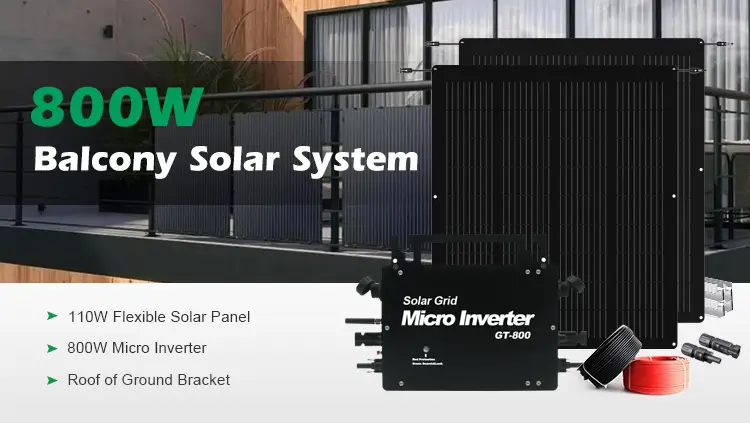
Meeting the strict physical demands covered in this apartment solar guide requires fully integrated engineering. Piecing together mismatched components rarely yields optimal results in tight spaces. We developed a comprehensive package merging high-yield generation with industrial-grade battery retention.
The Micro Complete 800W Balcony Solar System reflects our targeted approach toward practical green electricity for apartments. We crafted this specific hardware solution to maximize both operational uptime and financial return within the tightest urban boundaries.
Key Specifications and Performance Integration
This system architecture links high-efficiency photovoltaic generating modules directly with a rugged micro-inverter and a high-capacity internal battery reserve. We engineered the circuitry to ensure every captured watt receives optimal routing.
Incorporating the MPPT technology solar inverter guarantees the apartment solar panels perform at peak levels from dawn to dusk. The hardware adapts instantly to the variable partial shading common on city terraces. Built for harsh, continuous outdoor exposure, the critical components carry strict IP54 protection ratings. This ensures superior resistance against airborne dust and heavy water intrusion, guaranteeing long-term operational stability. Furthermore, the hardware maintains its efficiency across a remarkably broad thermal range. The intelligent air-cooled system functions reliably from extreme cold at -25°C all the way up to intense heat at +60°C. This thermal resilience makes the unit highly dependable across wildly diverse global climates.
Day and Night Energy Independence
Standard, basic grid-tied arrays face one massive limitation. They completely lack the ability to utilize generated power after sunset. Our advanced plug-and-play balcony energy storage configuration bypasses this temporal mismatch by utilizing a highly efficient Lithium Iron Phosphate (LFP) battery reserve.
During peak daylight hours, the system logic prioritizes powering your active household loads first. Critically, it routes any surplus generation from the balcony solar system 800W directly into the LFP battery bank. Without storage, this excess power would export to the municipal grid, often for a negligible financial return.
Once solar generation stops in the evening, or when your local utility tariffs hit their peak pricing hours, the hardware automatically shifts its operation. It begins discharging the stored battery power back into your apartment’s circuit. This automated load management strategy secures a highly tangible degree of energy independence. It shields you from expensive evening utility rates and ensures you utilize 100% of the solar energy you generate.
Comprehensive Global Service and Reliability
Procuring home energy storage solutions demands absolute trust in both the physical hardware and the manufacturer’s long-term operational stability. Since our inception, we have maintained rigorous, multi-stage quality control protocols alongside a mandate for continuous technological upgrades.
Our specialized expertise in manufacturing fully integrated renewable hardware has driven rapid global expansion. Today, our products operate reliably across more than 100 countries and regions worldwide. We maintain a highly responsive, geographically diverse sales and technical support network. This infrastructure guarantees that every client receives prompt engineering assistance and definitive warranty coverage.
Our professional technical teams stand ready to supply accurate installation guidance and troubleshooting support. We prioritize ensuring your hardware deployment remains secure, compliant, and financially beneficial over its entire operational lifecycle. We view our clients as long-term partners in the global transition to sustainable power.
Take Control of Your Energy Needs Today
Urban residents now possess the exact tools required to achieve independent power generation. Deploying an engineered, highly efficient plug-and-play balcony energy storage unit drastically reduces your daily reliance on aging fossil-fuel grids. It permanently cuts monthly utility costs and allows you to actively participate in the clean energy transition.
The underlying technology works reliably today. It fits the exact physical realities and spatial constraints of dense living environments. If you want to evaluate exactly how a customized 800W balcony solar system can optimize your household power consumption, we advise consulting our engineering staff.
Please contact us to discuss your specific electrical infrastructure, review our full product catalog, and receive a site-specific technical assessment tailored precisely for your apartment’s layout and geographical location.
FAQ
Q: What makes an 800W balcony solar system ideal for apartments?
A: An 800-watt capacity balances generation needs with strict regulatory limits. It produces enough daily electricity to offset the baseline power draw of standard appliances like refrigerators and networking gear. Simultaneously, this specific wattage falls within most local electrical codes that permit simplified grid connections, allowing you to bypass extensive municipal permitting or the need to hire specialized electrical contractors.
Q: How does an MPPT technology solar inverter improve energy generation?
A: Maximum Power Point Tracking utilizes advanced control algorithms to continuously monitor and adjust the operating voltage of your solar array. Because urban balconies face highly variable light and complex architectural shading, the MPPT controller dynamically alters electrical parameters to keep the panels operating at peak efficiency. This capability increases total daily energy yield by 10% to 20% compared to basic hardware lacking active tracking features.
Q: Is the installation process for DIY balcony solar complicated?
A: Engineers designed modern plug-and-play balcony energy storage specifically to remove deployment friction. The physical hardware mounts to standard metal or concrete railings using the provided adjustable, high-strength brackets. The electrical connection simply involves plugging the micro-inverter’s output cable directly into a standard dedicated household wall socket. This design completely eliminates the requirement for structural drilling or invasive household wiring.