

LiFePO4 vs Lead-Acid Battery: Which Is Better for Solar Battery Storage in 2026?
Time : Apr 27, 2026 View : 917

For most solar projects in 2026, LiFePO4 is the better choice. The reason is not trend alone. It is the result of a more practical question: which battery chemistry gives stable daily cycling, more usable energy, lower maintenance, and better long-term cost control in real solar work.
That question matters more now because solar battery storage is no longer limited to simple backup. Buyers expect a system to support nightly consumption, weak-grid operation, off-grid power, and cleaner replacement planning for aging lead-acid banks. In that setting, the battery is not just a spare part. It becomes the working core of the whole energy storage system.
Why this comparison matters more in 2026
Solar buyers previously concentrated mainly on the initial battery price. This remains a factor in the choice. However, it does not suffice anymore. In 2026, projects are judged more by cycle life, charge efficiency, usable capacity, service intervals, and how well the battery fits a real application.
This change is simple to describe. A battery that seems inexpensive at the start may turn costly in the long run. It often needs frequent swaps. It provides less effective capacity. It also demands more work. In contrast, a battery that stores greater useful power remains reliable for many years. As a result, it can cut idle periods. It can also lower the overall expense. This explains why the LiFePO4 versus lead-acid debate has grown key in battery storage planning for solar homes, remote sites, RV power, telecom backup, and small commercial systems.
This identical reasoning holds true for every solar installation with regular cycling. A battery gets charged in daylight hours. Then it discharges once more after dark. At that point, the difference in effectiveness shows up a lot more obviously. Consider a basic battery energy storage system. Here, the selection of battery type influences not just operating time. It also affects how the unit charges. Plus, it impacts pairing with inverters. And it shapes upkeep efforts.
Cycle life, usable energy, and charge efficiency
The first technical difference is lifespan under repeated cycling. Lead-acid can still work in light-duty use, but LiFePO4 is built for more frequent charge and discharge. That makes a direct difference in solar battery storage, where the battery often works every day rather than sitting idle.
Cycle life changes the real cost
A lead-acid battery may appear attractive at first because the entry price is lower. The problem is replacement frequency. If the system cycles regularly, that lower entry price can be offset by shorter service life and extra labor. For solar users, this becomes a long-term operating issue rather than a one-time purchase decision.
LiFePO4 performs better here because it is more suitable for deep and repeated cycling. That is one reason it is replacing lead-acid battery banks in many 24V and 48V systems. In simple terms, fewer replacements mean lower disruption, lower maintenance planning, and better value over the service life of the system.
Usable capacity matters more than nameplate capacity
A second issue is usable energy. Two batteries can show similar rated capacity on paper, but not deliver the same practical result in the field. Lead-acid usually cannot be discharged as deeply on a routine basis without shortening life. LiFePO4 offers much better usable output, which makes system sizing more honest and more efficient.
Charge efficiency is also important. In solar applications, every charging hour matters, especially in winter, on cloudy days, or in sites where the PV window is short. A battery with higher charge and discharge efficiency allows more of the harvested solar power to become usable energy. That improves daily system performance and supports a more effective energy storage system instead of forcing the PV side to compensate for battery losses.
Weight, maintenance, and daily system operation
Performance on paper is one thing. Daily operation is another. In real projects, weight, wiring, storage conditions, and monitoring access all influence the final battery choice.
Lighter systems are easier to deploy
Lead-acid is heavy, and that creates design limits in transport, handling, and installation. This is especially relevant for mobile systems, small equipment rooms, remote cabins, and retrofit projects where installers need a practical lead-acid replacement battery rather than a full redesign.
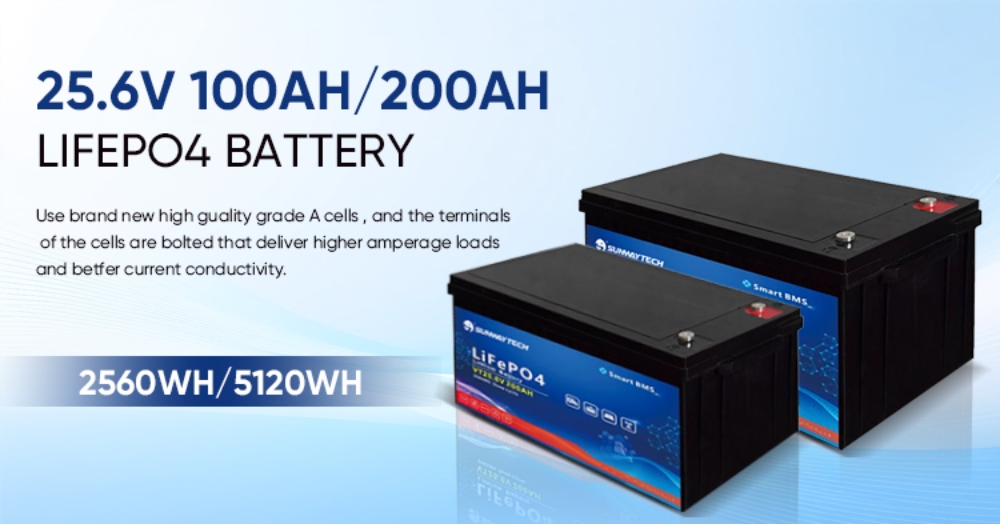
A modern drop-in LiFePO4 battery reduces that burden. The SUNWAY 2.56kWh / 5.12kWh Drop-In LiFePO4 Battery (25.6V) is a useful example. It is available in 25.6V 100Ah and 25.6V 200Ah versions, equal to 2.56kWh and 5.12kWh, and it is designed as a drop-in solution for solar and backup use. The product uses LiFePO4 chemistry, an ABS case, M8 terminals, IP65 protection, and a 4P smart Bluetooth BMS. It is also positioned as lighter than standard SLA batteries while delivering stronger practical output. Those points make it relevant for 24V battery storage upgrades where users want a simpler replacement path instead of a full battery room rebuild.
Lower maintenance improves reliability
Lead-acid systems often bring more maintenance demands over time, especially when the installation environment is warm, dusty, damp, or only visited periodically. Self-discharge and long idle periods can also create service problems.
LiFePO4 is usually easier to manage in these conditions. For solar battery storage, that means better consistency in standby use, seasonal use, and intermittent off-grid power applications. The Sunway 25.6V models are specified with low self-discharge, IP65 protection, and integrated Bluetooth BMS visibility, which helps users review battery status more directly instead of relying on rough voltage checks alone. The product page and supporting material also position the series around 3000+ full charge cycles and easier handling compared with SLA alternatives.
Where lead-acid still fits, and where LiFePO4 is the stronger option
A balanced guide should also be clear about the cases where lead-acid still has a place. It has not disappeared, and not every project needs lithium from the start.
When lead-acid can still make sense
Lead-acid can still be reasonable in low-budget systems with very light cycling, short-term use, or legacy installations already designed around that chemistry. If the battery is mainly for emergency reserve and is rarely discharged deeply, the performance gap may matter less than capital cost.
It can also fit projects where the buyer accepts higher weight and shorter replacement cycles because the system itself is temporary or lightly used. In these cases, lead-acid remains a workable option.
When LiFePO4 is clearly better
LiFePO4 is usually the better fit when the project will cycle often, when installation weight matters, when users need more usable energy from the same nominal capacity, or when service access is limited. It is also stronger in applications where daily solar charging must be converted into stable backup power at night with less loss.
That includes cabins, remote telecom loads, mobile systems, weak-grid homes, and many small commercial sites. In those cases, the battery is active rather than passive. Once the system works that way, a lead-acid battery becomes the limiting component more quickly than the PV array or inverter.
A practical product fit for 24V solar systems
Product choice should always follow the load profile, not only chemistry preference. A 24V battery storage layout is common in smaller solar systems because it balances manageable wiring, practical inverter matching, and reasonable capacity expansion.
For lighter daily loads, a 25.6V 100Ah battery can fit essential lighting, communications, and moderate backup power. For longer runtime or heavier cycling, 25.6V 200Ah gives a stronger margin for overnight support or frequent discharge. In both cases, the battery should be selected together with PV input, inverter size, cable sizing, and expected discharge window.
This is also where supplier support matters. A battery may be technically sound but still fail to perform well if the charging logic, operating temperature, or inverter settings are not matched correctly. Sunway works across solar panels, solar inverters, energy storage batteries, off-grid systems, household storage, C&I ESS, and utility-scale solutions. Its service materials also emphasize flexible delivery and customization, seamless on-grid and off-grid operation, manufacturing support, and global technical and after-sales support. For B2B buyers, that matters because product selection is only one part of reliable deployment.
What buyers should check before making the switch
A chemistry upgrade should solve a system problem, not create a new one. Before replacing a lead-acid battery bank, buyers should confirm five points.
First, check voltage compatibility. A 24V battery storage design must be matched to the inverter and charge settings, not assumed. Second, check usable load profile. Nighttime load and discharge depth matter more than rated capacity alone. Third, review environmental conditions. Temperature, dust, and humidity still affect the wider system even if the battery chemistry is more robust. Fourth, confirm monitoring needs. A Bluetooth BMS can be valuable in sites where technicians do not inspect the battery every day. Fifth, think about service and expansion. A good battery storage plan should still work when load grows or operating conditions change.
In 2026, LiFePO4 does not serve as the default option for all projects. Yet, many solar battery storage uses call for frequent cycling. They also demand reduced upkeep. Plus, they seek solid long-term costs. In those situations, this choice stands out as the superior one. Lead-acid still works well for a small set of low-need scenarios. For the bulk of other efforts, LiFePO4 provides a more useful route. It leads to dependable battery energy storage system operation. It also boosts off-grid power aid. And it eases the burden of replacements across years.
Contact Sunway for System Matching
For buyers evaluating a lead-acid replacement or planning a more reliable solar battery storage upgrade, project fit matters as much as battery chemistry. Battery voltage, cycling profile, inverter compatibility, installation conditions, and future expansion all affect long-term performance. For more targeted product selection and system matching, contact us to discuss the right Sunway solution for your application.
FAQ
Q:Can a LiFePO4 battery directly replace a lead-acid battery in a solar system?
A:In many cases, yes, but voltage, charge settings, inverter compatibility, and cable sizing still need to be checked. A drop-in form factor makes installation easier, but system matching is still necessary.
Q:Why does usable capacity matter more than rated capacity?
A:Because the rated figure alone does not show how much energy can be used repeatedly without harming battery life. In solar use, daily usable output is often more important than the nameplate number.
Q:Is a Bluetooth BMS important in small solar systems?
A:It can be very useful, especially in remote or lightly staffed sites. It gives quicker access to battery status, which helps with maintenance planning and early fault detection.