

How Can Businesses Manage Unreliable Power with Solar and Storage?
Time : Nov 16, 2026 Tingnan: 89
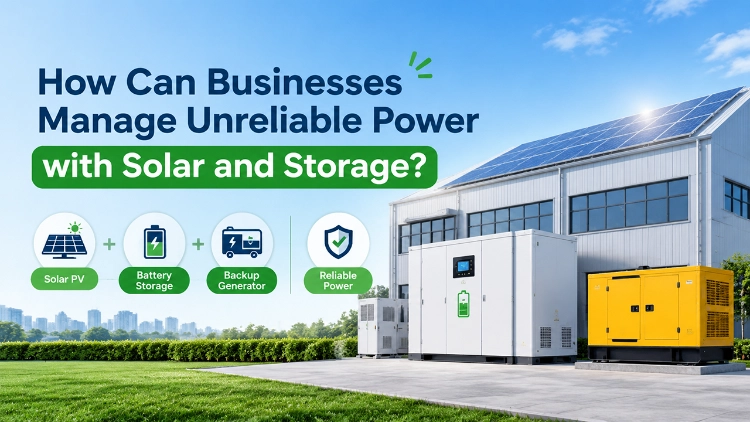
Solar PV modules generate electricity from sunlight, while batteries store energy for later use. Backup performance depends on inverter capacity, usable battery energy, grid-isolation equipment, and control settings. Where installed and correctly integrated, a generator can supply additional power when solar output and battery reserve are insufficient.
Why Does Unreliable Grid Power Create Problems for Commercial Sites?
The impact depends on the facility. A warehouse may need refrigeration controls and security to remain active, while a factory may need to protect process pumps, control panels, or production equipment that is costly to restart. Agricultural sites may depend on pumps or handling equipment at specific times.
Separate critical loads from equipment that can be paused. Keeping an entire facility online may require much more power and energy than protecting selected circuits. A load-priority list determines which equipment receives backup power first and which can be disconnected if battery energy becomes limited.
This article focuses on utility interruptions. Voltage and frequency disturbances or other power-quality problems may require separate equipment; a battery cabinet alone does not correct every electrical disturbance.
How Does a Hybrid Solar Power System Coordinate Its Energy Sources?
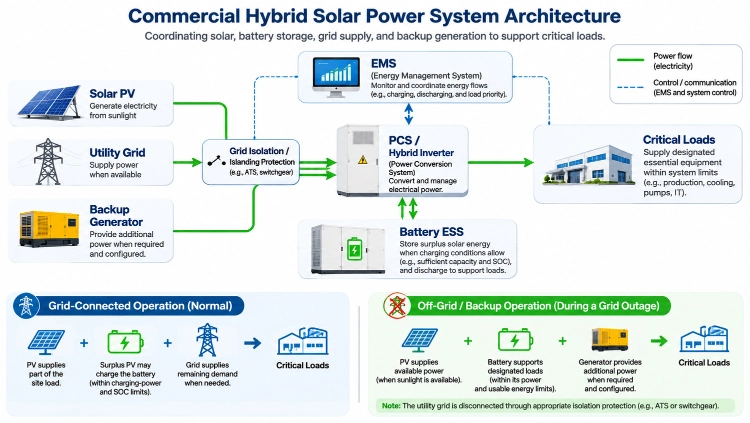
A commercial hybrid power system typically combines solar PV, battery energy storage, power conversion equipment, a utility connection, and, where required, a backup generator. An energy management system (EMS) coordinates energy flows using PV availability, battery state of charge (SOC), site demand, and operating priorities. Actual functions depend on the inverter, switchgear, and system architecture.
During normal grid-connected operation, PV supplies part of the facility’s demand. Surplus generation may charge the battery within its charging-power and SOC limits; stored energy can support selected loads when solar production falls or demand rises. The grid remains an additional source where permitted.
The operating strategy should reflect the site’s load profile. Charging windows, battery reserve settings, conversion losses, and power limits affect how much PV energy can be used on site. Self-consumption and backup reserve priorities should be defined before commissioning.
What Must Be in Place for Solar and Storage to Operate During an Outage?
A conventional grid-connected PV installation generally shuts down when utility power is lost, partly to prevent it from energizing lines under repair. To supply loads during an outage, the system needs suitable inverter functions, battery storage, grid-isolation equipment, and backup controls. The U.S. Department of Energy’s overview of solar and resilience explains how properly configured solar-plus-storage systems can operate in an islanded mode.
In islanded operation, the site is separated from the utility before local sources supply designated circuits. The inverter and controls must maintain the local supply. PV contributes when sunlight is available, while the battery balances changes between generation and demand. If PV is insufficient and the battery reaches its reserve limit, the system may need generator support or load shedding.
Cloud cover, shading, season, and time of day affect solar output. If the battery is full, PV output may need to be limited; if the battery is depleted, solar alone may not carry the site through a sudden load increase. The backup design should specify supported circuits, operating priorities, and the response when available energy is low.
How Can Solar and Battery Storage Support Businesses During Power Outages?
Power and energy describe different capabilities. The power rating in kilowatts (kW) indicates how much load a system can supply at a given moment; energy capacity in kilowatt-hours (kWh) describes the amount stored. A battery may have sufficient energy for several hours but still be unable to start a motor if inverter output or overload capability is insufficient.
Record each essential circuit’s running power, startup demand, operating pattern, and priority. Check whether motors, compressors, and pumps can run together or need to be sequenced. Continuous output, overload capability, phase arrangement, and power factor must match the actual equipment.
A preliminary estimate is:
Estimated runtime (hours) = available battery energy (kWh) ÷ average supported load (kW).
When Does a Backup Generator Add Value to a Solar and Storage System?
A battery can supply stored energy, but its contribution is limited by available energy and discharge power. PV can replenish some energy during daylight, although weather and site conditions affect production. During a prolonged outage, a generator can provide another source when PV and battery reserve cannot support required loads.
Ang Cybersecurity and Infrastructure Security Agency’s resilient-power guidance discusses combining renewable generation, storage, and backup generation to improve resilience and extend available fuel supplies. Results depend on site conditions and operating strategy; no fixed fuel-saving percentage should be assumed.
Confirm that generator voltage, phase, frequency, and available kVA match the ESS input requirements. A generator input does not by itself confirm automatic start/stop, synchronization, or load-sharing capability; these functions depend on the equipment and control design.
Which Commercial Sites May Benefit from Hybrid Solar Storage?
A hybrid solar battery generator system is worth assessing when an interruption has a material operating impact and the site can use local generation and storage. Suitability depends on load profile, outage exposure, critical equipment, and installation conditions.
Manufacturing sites may prioritize control systems, selected production equipment, and process pumps. Restart sequences matter where a short interruption can cause product loss or delay production.
Warehouses and cold-storage facilities may prioritize refrigeration controls, monitoring, and selected cooling equipment. Compressor startup demand and the required holdover period need review; average energy use alone may hide a high instantaneous load.
Agricultural processing and water-related facilities may depend on pumps and handling equipment. PV can contribute during daylight, while storage can shift energy to other operating periods. A generator may still be needed during prolonged outages or periods of limited solar availability.
These are project types to assess, not a claim that one cabinet can support every facility. Three-phase requirements, motor starting, backup duration, and protected circuits affect the final configuration.
What Should Buyers Check Before Selecting a Hybrid ESS?
When evaluating commercial solar battery storage, buyers should prepare:
|
Information to prepare |
Why it matters |
|
Critical-load list and running/startup power |
Establishes output and load sequencing |
|
Target backup duration |
Defines usable-energy needs |
|
Interval load data |
Shows when loads rise or overlap |
|
PV size and generation profile |
Indicates solar contribution |
|
Generator nameplate and electrical data |
Checks input compatibility |
|
Grid voltage, phase, and frequency |
Confirms electrical configuration |
|
Site temperature, altitude, and installation conditions |
Identifies environmental limits and derating |
|
Local codes and utility requirements |
Identifies protection and interconnection obligations |
The engineering review should also cover grid isolation, transfer behavior, grounding, overcurrent protection, fire provisions, communication, and maintenance access. Sensitive equipment that cannot tolerate even a brief interruption may need a separate uninterruptible power supply (UPS). CISA recommends a high-quality UPS for critical systems requiring continuous power until standby generation is available. It also notes that a BESS may suit systems that can tolerate tens or hundreds of milliseconds without power. A BESS is not a universal UPS replacement.
How Can SUNWAY Support a Commercial Hybrid Power Project?
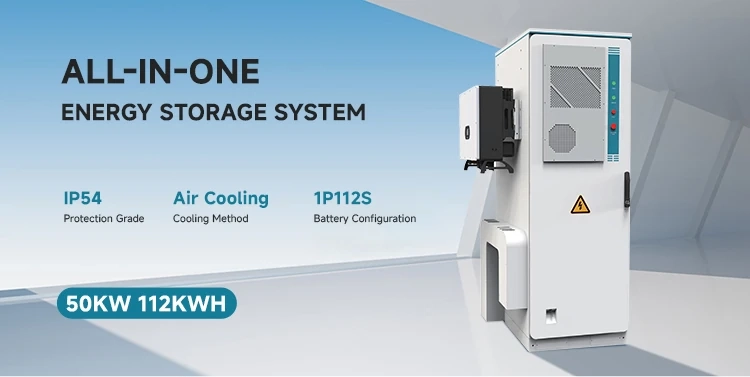
SUNWAY offers energy storage equipment for commercial and industrial projects. One example for a site-specific assessment is the SUNWAY Outdoor Cabinet ESS 50kW 112kWh.
The SW-50kW112kWh product page specifies a 112 kWh LFP battery, 50 kW rated AC output in both on-grid and off-grid operation, and a 0.5C charge/discharge rate. It lists maximum PV input of 100 kWp through four MPPT channels and generator input up to 60 kVA. The listed switching time is below 20 ms. The cabinet includes a dedicated generator input. Confirm its allowable input power, current, voltage, and operating conditions in the project-specific technical documentation before selecting or integrating a generator.
These specifications are relevant to projects combining PV, storage, and generator input, but they do not establish outage runtime. Buyers must compare the 50 kW output with simultaneous load demand, determine usable battery energy, and confirm generator compatibility. The product page lists a 50 Hz rated frequency, so other markets require configuration confirmation. It mentions parallel operation but does not state a maximum unit count. The below-20-ms switching figure must be checked against connected-load tolerance and is not a blanket UPS guarantee.
Planning backup power for critical loads? Send SUNWAY your load list, running and startup demand, target backup duration, site voltage and frequency, and existing PV or generator details. Request a configuration review covering inverter output, usable energy, load sequencing, and generator compatibility.
Konklusyon
Solar, battery storage, and a generator can complement one another when a system is designed around critical loads and operating priorities. Configuration depends on required power, usable energy, outage duration, PV availability, and generator compatibility. See the guide to sizing a C&I ESS without overbuilding or undersizing for the related power and energy assessment.
Mga Madalas Itanong (FAQ)
Q1: Can solar panels keep a business running during a grid outage?
Not in most conventional grid-connected installations. Suitable inverter functions, battery storage, grid-isolation controls, and designated backup circuits are required. Supported loads and runtime depend on system design and available energy.
Q2: Does a hybrid solar battery system always need a generator?
No. A generator may be useful when outages can outlast battery reserve and available solar production. The decision depends on outage history, backup duration, fuel availability, and the cost of additional storage.
Q3: How do businesses estimate the battery capacity needed for backup?
Start with critical loads, simultaneous power demand, and required backup duration. Then account for usable energy, inverter limits, startup demand, losses, reserve settings, and possible solar recharge. A site load profile is more useful than monthly consumption alone.