

How Does a Solar EV Charging Station with Battery Storage Work?
Time : Oct 05, 2026 View : 163
A DC fast charger can add a large, concentrated electrical load to a site that may already be close to its grid limit. Installing the charger is only one part of the project. Securing enough power at the required time can become the greater constraint.
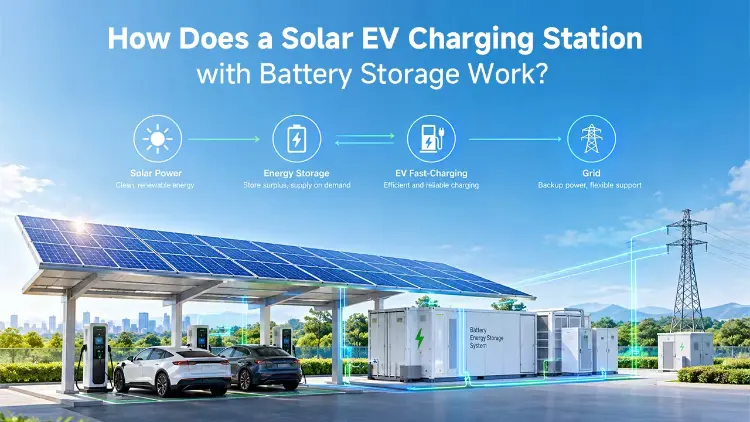
A solar EV charging station with battery storage addresses this by coordinating PV generation, stored energy, grid supply, and charger demand. The battery can absorb solar energy when charging demand is low, support chargers when demand rises, and reduce short periods of high grid import. The value comes from how these resources work together rather than from any one component alone.
What Is a Solar EV Charging Station With Battery Storage?
A solar EV charging station with battery storage combines PV generation, a battery energy storage system, grid connection where available, EV charging equipment, and an energy management system. The EMS monitors available sources and loads, then controls how power should move through the site.
Fast-charging demand can exceed instantaneous PV output, while solar generation varies through the day. Storage helps bridge that timing and power mismatch.
How Does Energy Move Through a PV-ESS-Charging System?
The power path depends on solar output, battery SOC, grid conditions, site load, and charger demand.
Solar Power Can Serve More Than One Destination
When PV output is available, solar energy may support charging, charge the battery, or reduce grid import. If generation exceeds immediate charging and site demand, part of the surplus can move into storage within the battery’s charging limits.
An EV is not always charged directly from solar. Cloud cover, evening charging, or high charger load can require battery or grid power.
Battery Storage Moves Energy Across Time
Battery storage separates the timing of solar generation from vehicle charging. Midday solar can be stored and used later, while the same battery may also provide short-duration support during a charging peak.
Its contribution depends on usable energy, discharge power, SOC reserve, and event duration. A battery sized only from daily kWh can still be too weak for a short high-power event.
Grid Power Covers the Remaining Gap
Where a grid connection is available, it can supply part of charger demand, recharge the battery during selected periods, or supplement PV when solar output falls.
The objective is often to keep grid import within a defined range while PV and storage cover part of the variable charging load.
Why Does an EV Fast-Charging Site Need Battery Storage?
Battery storage is most useful when it solves a measurable constraint.
Charger Demand Can Exceed Available Grid Headroom
A commercial property may already use much of its electrical capacity. Adding 120 kW or 240 kW of charging demand can create a new peak. A BESS can discharge during that event and reduce extra grid draw, but this does not automatically eliminate a grid upgrade. Charger utilization, battery power, discharge duration, and local connection rules still matter.
Solar Generation and Charging Demand Rarely Match Exactly
Solar output follows daylight conditions, while charging demand follows vehicle behavior. A charging hub may be quiet during strong midday solar and busier later. Fleet vehicles may also return within a narrow time window.
Storage can capture part of this mismatch instead of exporting or curtailing all surplus PV.
The Battery Can Limit Short Grid Peaks
When several vehicles charge at once, the EMS can discharge the battery to help cap site import. The same strategy may support peak shaving or demand management where tariffs and grid conditions make those objectives relevant.
Can Solar Power Really Support DC Fast Charging?
Yes, but solar output should not be treated as a fixed power source. A 120 kW charger does not require exactly 120 kW of PV, and a 120 kW PV array will not continuously provide 120 kW to a charger.
PV output changes with irradiance, weather, and time of day, while charger demand changes as vehicles connect and follow their charging curves. A practical design therefore evaluates PV, battery storage, and grid contribution together, with both kWh and kW matched to the site profile.
How Does the EMS Coordinate Solar, Battery, Grid and Chargers?
The EMS coordinates generation, storage, grid supply, and charging demand while keeping the site within battery, charger, and grid limits.
It Tracks the Conditions That Affect Power Flow
The EMS compares PV output, battery SOC, grid import, site load, and EV charger demand. These values can change independently: solar generation may fall as several vehicles begin charging, or the battery may approach minimum SOC during a high-load period.
If charger demand rises while grid import is already near the site limit, additional battery discharge may be needed. Strong PV generation may instead create an opportunity to recharge the battery or reduce grid consumption.
It Sets Dispatch Priorities Around the Site Objective
One site may prioritize solar self-use, while another may focus on limiting grid import or preserving battery reserve for later charging peaks.
A typical strategy may use available PV first, discharge the battery when charger demand would exceed the grid limit, and retain a minimum SOC for backup or later peaks. During lower-demand periods, the battery may recharge from PV or the grid if the operating strategy permits it.
These objectives compete for the same stored energy, so the EMS must manage both immediate demand and energy needed later.
If PV, battery discharge and permitted grid import cannot meet demand, charging power must be reduced or charging sessions prioritized within the site’s operating limits.
It Coordinates Charging Equipment and System Communication
The EMS also needs reliable communication with chargers, battery controls, meters, and monitoring platforms. Communication can support charger status, load management, faults, remote operation, and user access. Protocols such as OCPP and Modbus exchange data, but the site still needs clear rules for charger priority, grid import, reserve, and power limits.
Can the Station Continue Charging During a Grid Outage?
PV, storage, and a charger do not automatically guarantee operation during a utility outage. Island operation requires compatible controls, safe grid isolation, adequate battery SOC, sufficient discharge power, charger compatibility, and protection logic.
The charging load also has to fit available island-mode power. A battery may contain enough energy for hours yet lack the instantaneous power required by multiple fast chargers. Grid-connected and off-grid capability must therefore be confirmed at system level.
What Determines the Right PV, Battery and Charger Size?
Charger nameplate power is only one input. Sizing should begin with how the site will actually be used.
Charging Demand Defines the Required Power Profile
Check daily sessions, simultaneous chargers, average and peak power, dwell time, and vehicle turnover. A 240 kW charger may rarely operate at full output, while several lower-power sessions can still create a sustained peak.
Grid Capacity Defines the Power Gap
The key sizing question is the gap between charger demand and available grid headroom, together with how long that gap lasts.
Assuming a charging demand of 120 kW, the grid power available for charging after deducting other loads is 80 kW, with no contribution from PV; ignoring conversion losses for now, the shortfall is 40 kW. Assuming this continues for one hour, the load side will need to replenish 40 kWh. The actual rated battery capacity must also take into account the usable SOC range, losses, auxiliary loads, degradation, and reserve capacity; therefore, one cannot simply select a “40 kWh battery.”
PV Generation Defines the Renewable Contribution
PV capacity, hourly production, seasonal variation, and site consumption determine how much solar energy can reach the battery or chargers. Annual generation alone does not show timing.
Future charger expansion and backup reserve should also be included before configuration is fixed. The PV ESS Charging System range provides a broader view of integrated solar, storage, and charging configurations.
Where Does Solar Plus Storage Fast Charging Make the Most Sense?
The architecture is most relevant where charging demand, grid limits, and solar generation create a clear power-management problem. Highway service areas may need high power over short stops. Commercial parking can combine daytime PV with vehicle dwell time and building loads. Fleet depots may see predictable return-time peaks, while grid-constrained sites may use storage to limit additional utility draw.
These are different operating cases, so battery capacity and charger power should not be copied from one site to another without reviewing the load profile.
What Does an Integrated PV-ESS Fast-Charging System Look Like?
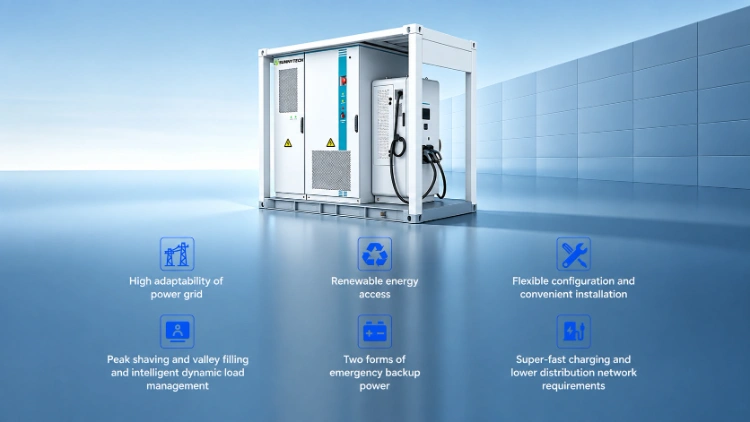
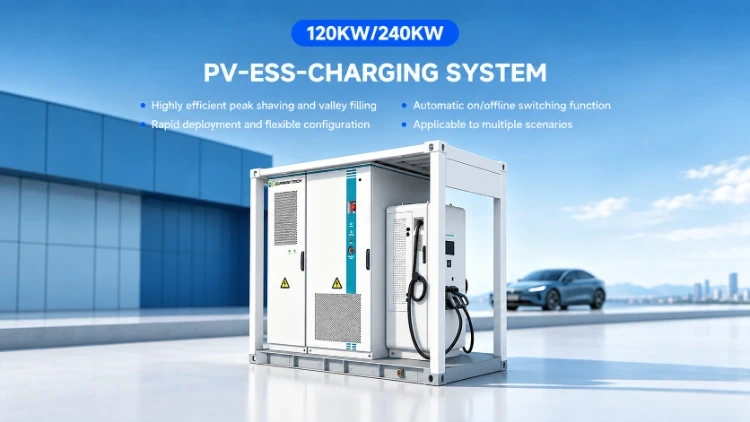
At Sunway, we integrate PV input, battery storage, charging equipment, energy management, and grid interaction around the required site power flow.
Both configurations use a 0.5C battery charge/discharge rate, intelligent liquid cooling, direct DC PV connection, 150–1000 V charging output, OCPP 1.6, and Modbus communication. They are designed for both grid-connected and island operating modes.
The final design must match grid capacity, PV potential, charger utilization, reserve requirements, protection, and expansion.
Check the Site Power Balance Before Adding Fast Chargers
Before selecting charger quantity or battery capacity, define the site’s available grid power, expected charging profile, PV potential, operating hours, and required reserve.
Share those inputs with us to review your PV-ESS charging project. A useful design should show how power is expected to come from the grid, PV, and battery during critical periods rather than starting from charger nameplate power alone.
FAQ
Q: Can a solar EV charging station work when solar output is low?
A: Yes, if another source such as battery storage or the grid is available. The EMS can coordinate those sources based on PV output, battery SOC, charger demand, and operating priorities.
Q: Can battery storage reduce the grid capacity needed for DC fast charging?
A: It can reduce short periods of grid demand by discharging during charging peaks. Whether this reduces or avoids a grid upgrade depends on the power gap, duration, charger utilization, battery capacity, and local grid requirements.
Q: How large should the battery be for an EV charging station?
A: Battery size should be based on the required power gap and how long it lasts, together with charger utilization, available grid capacity, PV generation, SOC reserve, site load, and future expansion. Charger rated power alone is not enough.