

What Does Battery C-Rate Tell You About Power and Runtime?
Time : Sep 28, 2026 عدد المشاهدات: 155

Two batteries can store the same amount of energy yet support very different power levels. One may be designed for a moderate current over a longer period, while another can deliver much more current for a shorter period. Capacity alone does not explain that difference.
Battery c rate links current to battery capacity. It helps show how quickly charge can move into or out of a battery and gives a useful reference for theoretical runtime. For energy storage projects, however, c rate must be read together with voltage, usable capacity, BMS limits, inverter power, temperature, and the actual load. A battery with enough kWh can still be unable to support a load if its current or power limit is too low.
What Does Battery C-Rate Mean?
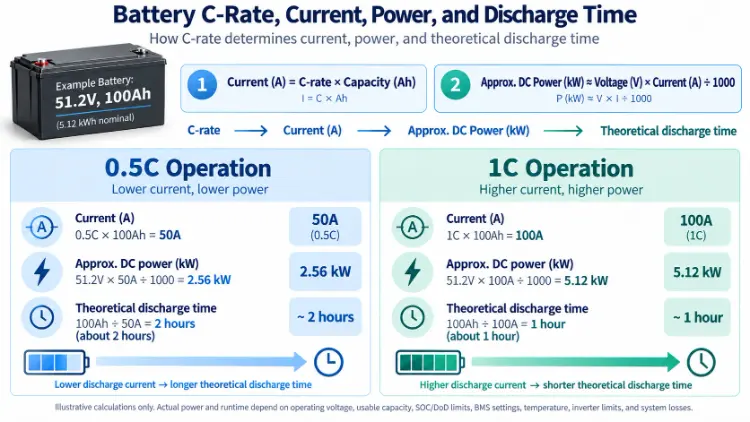
C-rate expresses charge or discharge current relative to the battery’s rated ampere-hour capacity. The basic relationship is:
C-rate = current (A) ÷ capacity (Ah)
For a theoretical 100Ah battery, 0.5C corresponds to 50A and 1C corresponds to 100A. A 2C discharge would correspond to 200A. These values show the mathematical relationship only. The permitted current must come from the battery specification and BMS limits.
Charge and Discharge C-Rates Can Differ
A battery does not always use the same limit for charging and discharging. One product may allow 0.5C charging but a higher continuous discharge rate. Another may specify the same current in both directions.
It is also important to separate continuous current from maximum or pulse current. A short peak rating may be intended for only a few seconds. It should not be used to estimate sustained power or runtime. For a storage project, the continuous charge and discharge ratings are usually more useful when matching the battery to an inverter or PCS.
How Do You Calculate Current From C-Rate?
The calculation can be reversed when the capacity and c rate are known:
Current (A) = C-rate × capacity (Ah)
A 100Ah battery operating at 0.5C gives:
0.5 × 100Ah = 50A
A 280Ah battery operating at 0.5C gives:
0.5 × 280Ah = 140A
The second example is useful because stationary LFP batteries often use larger-capacity cells or packs. The calculation does not prove that every 280Ah battery can safely operate at 140A. The manufacturer still has to specify the allowed current, and the BMS must enforce it.
How Does C-Rate Affect Battery Power?
Current becomes more useful to a system designer when it is connected to voltage. For a simplified DC calculation:
P ≈ V × I
If a 51.2V battery is allowed to discharge at 140A, the approximate DC-side power is:
51.2V × 140A ≈ 7.17kW
That is a theoretical electrical relationship, not a guaranteed AC output. Battery voltage changes with SOC and load, while the BMS, inverter, wiring, and temperature can all restrict real output.
Higher C-Rate Can Increase Available Power
At the same voltage and Ah capacity, a higher permitted c rate allows more current. That can support higher battery-side power if the rest of the system is designed for it.
A higher c rate is not automatically better. Higher current can increase heat and place more demand on conductors, connections, protection devices, and cells. The useful rate is the one that matches the load profile and operating duty.
Does C-Rate Tell You How Long a Battery Will Run?
C-rate provides a simple theoretical time relationship when a battery is discharged from its full rated capacity at a constant current:
- 1C corresponds to about 1 hour.
- 5C corresponds to about 2 hours.
- 25C corresponds to about 4 hours.
These are reference values, not guaranteed runtimes. Real battery runtime depends on how much energy is actually available and how the load changes during operation.
For example, a battery operating at 0.5C may have a two-hour theoretical discharge period, yet part of the SOC may be reserved for backup or protected by a minimum limit. If only 80% of rated energy is available for routine use, practical duration will be shorter.
This is why c rate and usable battery energy answer different questions. C-rate indicates how quickly charge is moved; usable energy determines how much of the stored energy is available for the task.
Why Can Actual Runtime Differ From the Simple Estimate?
Several limits sit between a theoretical c-rate calculation and the runtime seen at the load.
The Full Rated Capacity May Not Be Available
SOC limits, depth of discharge, backup reserve, battery aging, and operating conditions can reduce the energy available for a particular dispatch period. A large nameplate capacity does not mean the entire figure can be discharged on demand.
Loads Rarely Stay Constant
Real facilities do not draw perfectly flat power. HVAC compressors cycle, pumps start, motors accelerate, and EV chargers may ramp up or down. These changes alter battery current and therefore change how quickly stored energy is used.
The BMS and Inverter Can Restrict Output
A battery may allow a certain discharge current while the inverter is rated for less power. The opposite can also occur: an inverter may be capable of more output than the battery can continuously supply. The usable system power is limited by the lowest applicable constraint.
Temperature can also trigger current derating, while conversion and auxiliary losses reduce the energy that reaches the AC load. These effects should be included in system design rather than folded into the c-rate definition itself.
C-Rate, kW and kWh: What Is the Difference?
These terms describe related but different parts of battery performance.
|
Term |
What It Describes |
|
Ah |
Amount of electrical charge stored |
|
C-rate |
Current relative to rated Ah capacity |
|
A |
Actual charge or discharge current |
|
kW |
Power delivered or absorbed at a given moment |
|
kWh |
Energy stored or delivered over time |
|
Runtime |
Duration a load can be supported |
A common mistake is to treat the system power-to-energy ratio as if it were automatically the same as cell c rate. A 100kW/200kWh battery energy storage system has a two-hour nominal power-to-energy relationship, but that alone does not prove that every cell is operating at 0.5C.
Cell c rate is based on current relative to Ah capacity. System power also depends on string configuration, voltage, PCS limits, and control settings.
Why Can a Large Battery Still Have Limited Power?
Energy capacity and power capability solve different problems.
Consider two simplified systems. System A stores 200kWh but has a 50kW discharge limit. System B stores 100kWh but can discharge at 100kW. System A stores twice as much energy, yet System B can support the larger instantaneous load.
This distinction matters for backup, peak shaving, machinery, and fast-changing loads. Increasing kWh does not automatically increase kW. A project that needs a long discharge period may prioritize energy capacity, while a project with short high-power peaks may require more current and inverter power.
Battery storage should therefore match both the energy requirement and the highest sustained power the site must support.
What Should Buyers Check in a C-Rate Specification?
Before using c rate in a project calculation, check the surrounding specifications:
- rated Ah capacity
- nominal and operating voltage
- recommended charge current
- recommended discharge current
- continuous current
- maximum or pulse current and its duration
- BMS current limits
- inverter or PCS power limit
- SOC and DoD operating window
- temperature range and derating conditions
Peak current deserves particular attention. A short-duration pulse rating should never be treated as continuous discharge capability. The same applies to a laboratory test condition that does not match the intended site temperature or duty cycle.
For smaller storage projects, the Sunway residential ESS range provides different battery and system configurations that can be compared around capacity, power, and operating requirements.
What Does C-Rate Look Like in a Real Home Battery?

في صنواي, we use battery and inverter specifications together because Ah capacity by itself does not define system power.
ال بطارية تخزين الطاقة المنزلية من صن واي بسعة 14.33 كيلوواط ساعة is rated at 51.2V and 280Ah, with 14.336kWh nominal energy. Its recommended charge and discharge current is 140A, which corresponds to 0.5C for a 280Ah battery. The maximum charge/discharge current is listed as 200A, and communication is provided through RS485/CAN. The battery is specified for more than 6,000 cycles at 90% DoD.
This example shows why recommended current and maximum current should not be treated as interchangeable. The 140A figure gives a clear 0.5C operating reference. The 200A value is a separate maximum specification and should be used only within the conditions defined for the product.
Match Battery Power to the Load, Not Capacity Alone
A battery can have enough stored energy but still be undersized for the required power. Before selecting a configuration, define the peak load, target runtime, inverter rating, usable SOC window, and expected charging source.
Share these project inputs with us to review your battery power and runtime requirements. The aim is to align battery capacity, current, c rate, inverter power, and runtime before the final system size is fixed.
التعليمات
Q: What does 0.5C mean on a battery?
A: A 0.5C rate means the current equals half of the battery’s rated Ah capacity. For a 100Ah battery, 0.5C corresponds to 50A. The actual permitted current must still be confirmed in the battery specification.
Q: Does 1C mean a battery will always run for one hour?
A: No. One hour is the theoretical full-capacity relationship. Actual runtime depends on usable SOC, DoD, reserve, load variation, BMS limits, inverter efficiency, temperature, and other operating conditions.
Q: Is a higher C-rate always better for battery storage?
A: No. A higher c rate can support more current and potentially more power, but the project may not need it. Battery capacity, load profile, temperature, lifecycle targets, inverter limits, and wiring should be evaluated together.