

Is a 5kWh Home Battery Enough for Daily Household Backup?
Time : May 25, 2026 View : 253
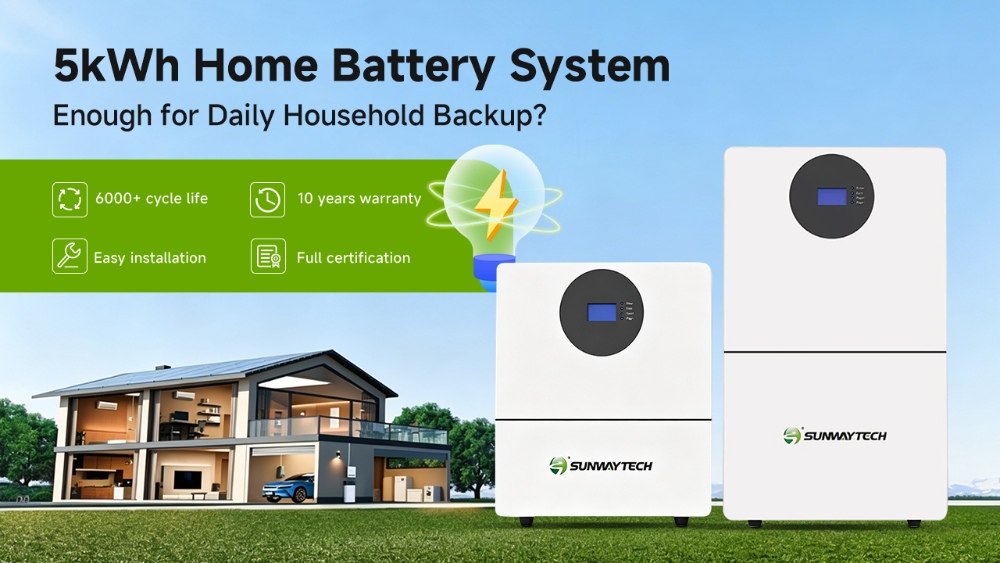
A 5kWh home battery can meet daily household backup needs when the backup target is limited to essential loads. It is not intended to keep every appliance in a house running without restriction. The final result depends on the household load list, outage duration, solar charging conditions, and the inverter used with the battery.
For many residential users, battery size is only part of the decision. A practical home battery backup plan starts with load priority. Lights, Wi-Fi equipment, refrigeration, phone charging, laptops, security devices, and small fans require a very different energy plan from air conditioners, electric ovens, dryers, or electric water heaters. Once essential and non-essential loads are separated, the value of a 5kWh battery becomes much clearer.
What a 5kWh Battery Can Realistically Do
A battery capacity label may look straightforward, but real backup performance depends on actual energy use. A battery around 5kWh stores a limited amount of energy. During an outage, that stored energy should be allocated to the devices that matter most.
Capacity is measured in kWh. Output power is determined by the inverter and system design. This distinction is important because a wall-mounted lithium battery stores DC power and cannot directly operate household AC appliances by itself. It must work with a compatible hybrid inverter or off-grid inverter to convert stored energy into usable AC electricity.
In a solar battery system, the battery is only one part of the installation. The inverter, solar panels, cables, communication settings, protection devices, and backup load design all influence performance. A reliable residential storage project is built through system matching, not battery selection alone.
Usable Energy Matters More Than the Label
Nominal capacity and usable capacity are not identical in many battery systems. A portion of the rated capacity is often reserved to protect battery health and extend service life.
For a home energy storage battery, usable energy gives a more accurate view of backup duration. A 5.12kWh battery may not provide the full 5.12kWh for normal discharge, depending on depth of discharge and system settings. This is a standard part of battery protection and long-term operation.
Usable energy is especially important when buyers compare products of similar nominal capacity. A product may appear similar on the label, yet deliver different practical backup time because of discharge limits, inverter settings, and system configuration.
Which Household Loads Should Be Backed Up First?
A sound backup plan should begin with essential circuits. Instead of asking whether one battery can operate the whole home, users should identify which devices must remain powered during a grid failure.
Essential Loads That Fit a 5kWh Battery
A 5kWh home battery is generally suitable for LED lights, Wi-Fi routers, refrigerators, phone chargers, laptops, security cameras, small fans, and selected low-power appliances. These loads support communication, food storage, basic safety, and daily convenience while keeping energy demand within a manageable range.
This is the main value of home battery backup for many households. A refrigerator works in cycles rather than at full power continuously. LED lighting consumes far less power than heating or cooking equipment. Internet equipment and charging devices are usually moderate loads. With proper load control, a smaller battery can still provide meaningful daily household backup.
High-Power Appliances Need Careful Planning
High-power appliances require more careful assessment. Large air conditioners, electric heaters, water heaters, dryers, induction cookers, and ovens can consume stored energy rapidly. Some of these appliances may also require higher inverter output, stronger wiring, and a more detailed protection design.
This does not mean such appliances can never be supported. It means they should not be treated as default backup loads without calculation. In residential energy storage projects, unrealistic expectations often create more issues than the battery itself. A clear load plan helps the battery operate within its proper application range.
When a 5kWh Battery Is Enough
A 5kWh battery is often suitable when the home needs short outage protection, essential circuit support, and better use of stored solar energy. It works best in homes where backup mode is managed rather than treated as normal full-house operation.
Short Outages and Basic Home Power
For homes with occasional grid interruptions, a 5kWh battery can keep key devices running. Lights remain available. Internet equipment can continue to work if the external network remains active. Refrigeration can be supported for a period. Phones, laptops, and security devices can stay powered.
This form of daily household backup focuses on continuity and basic function. It is not designed to maintain every comfort load during an outage. For many homes, this level of backup is already enough to reduce disruption and improve energy security.
Solar Recharging During the Day
Solar panels can make a 5kWh battery more valuable. During normal operation, solar power can supply household loads and charge the battery. In the evening, stored power can reduce grid consumption. During an outage, daytime solar generation may extend backup time if the inverter and system design allow this mode.
A solar battery system should therefore be evaluated as a complete power arrangement. Battery capacity, PV array size, inverter compatibility, charge and discharge current, and load priority all shape real performance.
When a Larger Battery Makes More Sense
A smaller battery is not the best match for every home. Some households require more stored energy because of longer outage risks, heavier evening demand, or higher comfort expectations.
Long Outages Without Solar Recharging
If blackouts often last many hours or more than one day, a 5kWh battery may become limited unless solar panels can recharge it. Even essential loads consume energy over time. Several low-power devices running together can still reduce available backup duration.
For this type of home, a larger battery or an expandable design may be more suitable. The objective is not to select the largest possible battery, but to match stored energy with the real backup requirement.
Why 10kWh May Be a Better Fit for Some Homes
A 10kWh-class battery gives more reserve for longer backup periods, higher evening use, and stronger solar self-consumption. It may suit homes with larger refrigeration loads, more lighting areas, frequent night-time use, or greater concern about grid instability.
A 5kWh battery is often a practical choice for essential backup. A 10kWh battery becomes more appropriate when users want longer support time and more stored solar power available overnight.
Key Specs to Check Before Choosing a Wall-Mounted Lithium Battery
A wall-mounted lithium battery should be evaluated by more than capacity. Buyers should also review voltage, usable energy, charge and discharge current, communication method, cycle life, safety design, installation environment, and certification.
Voltage, Inverter Compatibility, and Communication
A 51.2V battery platform is common in low-voltage residential storage systems. It can work with many hybrid and off-grid inverters when the electrical parameters and communication protocols are compatible.
Communication is important because the battery and inverter need to exchange operating data. RS485 and CAN support can help with battery status reading, charging control, and system protection. Optional Bluetooth can also support local inspection and maintenance.
Depth of Discharge, Cycle Life, and Protection
Depth of discharge affects usable capacity and long-term battery health. A 90% depth of discharge can provide higher usable energy while still protecting the battery from excessive discharge.
Cycle life also matters because batteries paired with solar panels may charge and discharge frequently. BMS protection is equally important because it helps monitor voltage, current, and battery behavior. For residential use, circuit breaker support and clear protection design improve safety during operation and maintenance.
Installation Space and Operating Conditions
Wall-mounted design can save floor space in garages, utility rooms, equipment rooms, and compact residential storage areas. However, wall strength, bracket design, cable routing, and service access should be reviewed before installation.
Temperature is another practical factor. A battery should be installed within its rated operating range and placed where ventilation, maintenance access, and electrical safety can be properly maintained. Careful installation planning protects both safety and long-term performance.
Why Supplier Capability Also Matters in Home Battery Projects
Battery capacity is only one part of a successful residential storage project. For installers, distributors, and homeowners, supplier capability can affect system matching, documentation, shipment preparation, delivery confidence, and after-sales support.
A capable supplier can help buyers check whether the selected battery matches the inverter, communication protocol, voltage range, installation layout, and backup target. This is especially important when a project uses a separate wall-mounted battery and inverter rather than a fully integrated all-in-one unit.
Product documentation also matters. Certification files, transport documents, battery safety information, and technical specifications can affect purchasing, compliance review, and project approval. For international buyers, CE, UN38.3, and MSDS documentation helps reduce basic review barriers before shipment.
Sunway works across solar panels, inverters, energy storage batteries, off-grid systems, grid-tied systems, and photovoltaic energy storage solutions. This broader product background is useful when customers need more than a single battery model. Battery selection often connects with inverter choice, PV sizing, backup load design, and future expansion. For wider planning, Sunway’s energy storage solutions can help match the product to the application rather than forcing one capacity into every home.
How the SUNWAY Wall-Mounted Battery Fits
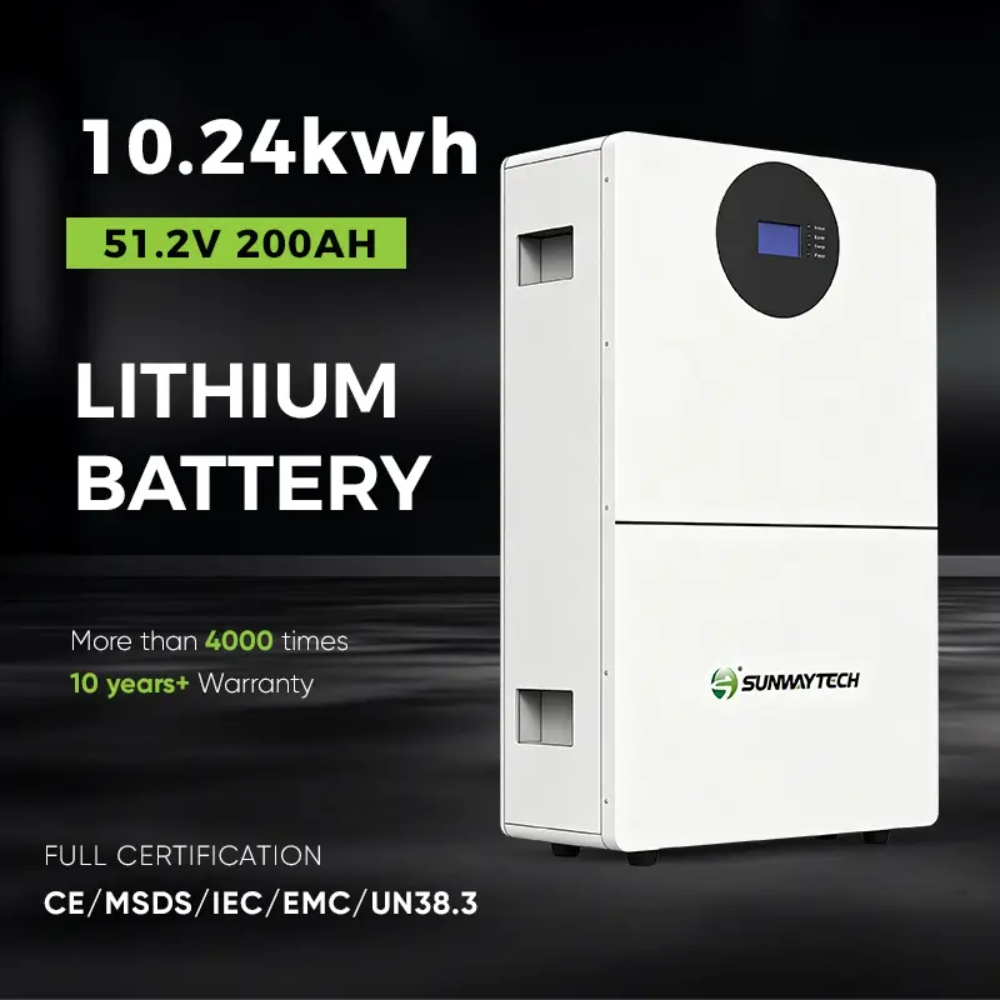
The SUNWAY 5.12kWh / 10.24kWh Wall-Mounted Lithium Battery is designed for residential storage and small-scale solar energy storage applications. It offers two capacity options: 5.12kWh with 100Ah capacity and 10.24kWh with 200Ah capacity. Both models use a 51.2V nominal voltage platform.
The 5.12kWh model provides 4,608Wh usable energy, while the 10.24kWh model provides 9,216Wh usable energy. The smaller model is suitable for essential backup and controlled daily use. The larger model provides more flexibility for longer backup periods and higher evening energy demand.
The product relies on LiFePO4 cells. It allows a 90% depth of discharge and runs at 0.5C. The design delivers at least 4,000 cycles at 25°C. RS485/CAN communication forms a standard part of the unit, while Bluetooth remains available as an optional function. Air cooling works together with BMS protection and circuit breaker support. The wall-mounted structure adds further practicality. These elements suit homes that prioritize efficient use of space, reliable safety measures, and straightforward installation.
Conclusion
A 5kWh home battery can be enough for daily household backup when it is used for essential loads, short outages, and controlled energy use. It is less suitable for long blackouts, full-home backup, or high-power appliances without careful planning.
The best choice depends on the actual load list. A 5.12kWh battery can support basic backup and solar energy storage. A 10.24kWh battery provides more usable energy for longer backup time and stronger evening power support.
If you are selecting a battery for a residential solar project, share your load list, inverter model, and backup target with our service team. We can help review whether 5.12kWh or 10.24kWh is more suitable for your installation.
FAQ
Q: Is a 5kWh home battery enough for daily household backup?
A: Yes, it can be enough for essential loads such as lights, Wi-Fi, refrigeration, phone charging, small fans, and security devices. It is usually not enough for long full-home backup with several high-power appliances running at the same time.
Q: Should I choose a 5.12kWh or 10.24kWh battery for home battery backup?
A: Choose 5.12kWh if the goal is basic backup and controlled solar storage. Choose 10.24kWh if the home needs longer backup time, higher evening energy use, or more stored solar power available overnight.
Q: Can a wall-mounted lithium battery work directly with household appliances?
A: No. A wall-mounted lithium battery stores DC energy. It needs a compatible hybrid or off-grid inverter to convert stored battery power into AC electricity for household appliances.